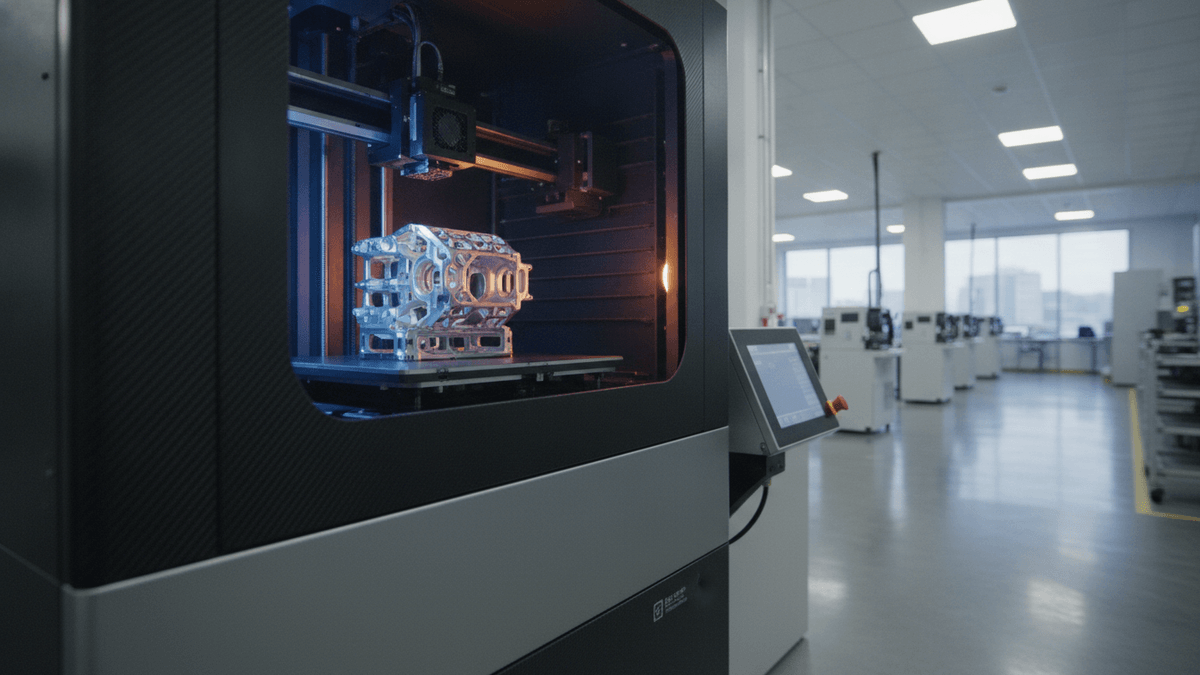
Industrial 3D printer fabricating a complex part in a modern manufacturing facility.
The European Union’s market for 3D printers is experiencing robust double-digit volume growth, with projections indicating an annual increase of 8-12% for industrial and professional systems through 2035. This expansion is largely attributed to a significant market shift, moving from traditional prototyping applications towards the direct production of end-use parts.
Polymer-based 3D printing technologies, including Fused Deposition Modeling (FDM) and Stereolithography (SLA), currently dominate the installed base, accounting for 60-70%. Concurrently, metal additive manufacturing systems, such as Direct Metal Laser Sintering (DMLS), are securing a larger portion of capital expenditure, ranging from 25-35%.
While the EU demonstrates a reliance on imports for desktop and professional 3D hardware, there is a notable expansion in domestic production of industrial-grade systems and high-performance materials. Key countries leading this domestic growth include Germany, Italy, and the Netherlands.
Market trends highlight the increasing importance of end-use part production, which now represents 40-50% of the market’s value. Furthermore, technologies like Multi Jet Fusion (MJF) and Binder Jetting are gaining traction for medium-to-high volume manufacturing applications.
Despite the positive growth trajectory, the market faces challenges such as high energy costs, fluctuating raw material prices, a shortage of skilled labor, and regulatory fragmentation across member states.
The market is forecasted to grow at a compound annual growth rate of 12-16% between 2026 and 2035, with professional and production systems expected to spearhead this expansion. Demand is segmented by technology, application, and end-use, with FDM technology maintaining the largest installed base. End-use part production is identified as the fastest-growing application segment.
Pricing structures within the market are diverse, heavily influenced by material and energy costs, particularly for energy-intensive processes. The competitive landscape includes both established domestic manufacturers and international suppliers, with Germany, Italy, and France identified as the primary demand centers.
The EU functions as a net exporter of industrial-grade 3D systems but relies on imports for entry-level hardware. Regulatory frameworks are continuously evolving to ensure safety, quality, and environmental sustainability, with mandatory compliance for CE marking and REACH regulations.
By 2035, additive manufacturing is anticipated to become a standard production technology across the EU. Significant opportunities are emerging in the development of advanced materials, sophisticated software solutions, and the expansion into Eastern European markets.
About the Author