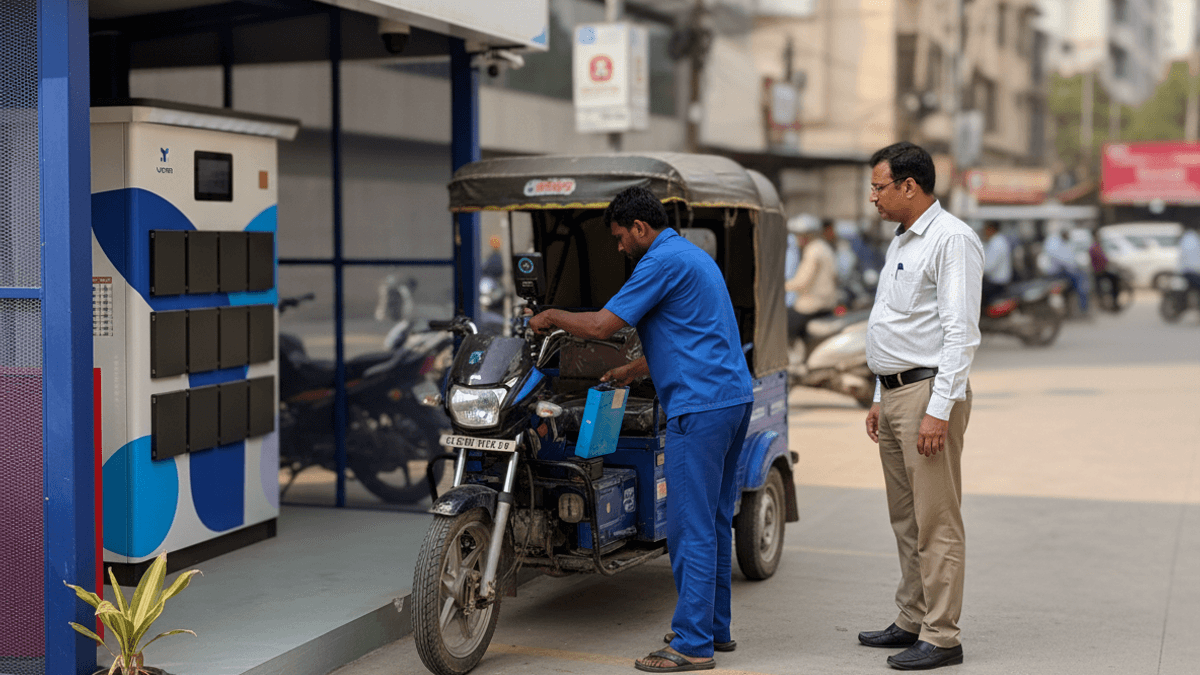
An e-rickshaw driver swaps a battery at a Yuma Energy station, observed by a company representative.
Yuma Energy Accelerates Diversification Beyond Yulu Roots
Yuma Energy, a key player in India’s electric vehicle (EV) battery-swapping solutions, is strategically pivoting to diversify its business beyond its foundational partnership with Yulu Energy. Managing Director Muthu Subramanian has projected that non-Yulu related business will account for approximately 25% of the company’s operations by the close of the current year. This ambitious target underscores Yuma Energy’s commitment to scaling its battery-as-a-service (BaaS) network to cater to a wider array of partners, including electric rickshaws and other light commercial vehicles, thereby tapping into the burgeoning Indian EV ecosystem.
Scaling the Battery-Swapping Network Across India
Founded in 2023 as a joint venture between automotive supplier Magna International and Yulu Energy, Yuma Energy has rapidly established a significant footprint. The company currently operates over 350 battery-swapping stations across approximately 18 cities, serving more than 45,000 customers daily. The primary drivers for this growth are delivery partners in the e-commerce and quick commerce sectors, who benefit immensely from the rapid, under-two-minute battery swap times, which are crucial for maintaining tight delivery schedules. This rapid expansion highlights the practical advantages of battery swapping as EV adoption accelerates in India, driven by lower running costs for high-usage vehicles.
Strategic Partnerships and Market Expansion
While initially focused on Yulu bikes, Yuma Energy has actively broadened its clientele since 2025. The company has forged partnerships with prominent Electric Two-Wheeler (E2W) Original Equipment Manufacturers (OEMs) such as Quantum Energy, Motovolt Mobility, Kinetic Green, and e-Sprinto, integrating its battery solutions into their respective vehicle platforms. Furthermore, Yuma Energy is extending its reach beyond two-wheelers, initiating the deployment of BaaS solutions for e-rickshaws in northern India and exploring opportunities in other electric light commercial vehicles. This multi-pronged approach allows Yuma Energy to address diverse market needs and vehicle types.
Evolving Battery Technology and Operational Models
Yuma Energy’s battery packs have undergone significant evolution to meet the demands of various vehicle segments. Initially designed for low-speed vehicles, the company has developed a new generation of battery packs offering nearly double the capacity and higher power output. These advanced packs are compatible with the same form factor, enabling them to support not only low-speed vehicles but also mid-speed scooters and three-wheelers requiring enhanced performance. This technological advancement is crucial for Yuma Energy’s expansion into new vehicle categories and partnerships.
The company employs a flexible operational model, utilizing a hybrid approach that includes both company-operated stations and a partner-led franchise model. In emerging markets or areas with lower initial demand, the partner-led model allows Yuma Energy to remain asset-light while validating market potential. Conversely, in high-demand or strategic metropolitan areas, a hybrid approach ensures efficient service delivery across different customer segments and vehicle types. This adaptability is key to its scaling strategy.
Financial Performance and Profitability Outlook
Yuma Energy is currently in a growth phase, with significant investments in scaling its infrastructure and operations, which has consequently delayed profitability. Muthu Subramanian stated, “We’re not profitable yet because we’re still in build mode. It’s only been about three years, and we’ve scaled quickly from around 50 stations to 350. That kind of rapid expansion naturally delays profitability, but we’re actively working toward it.” The company has experienced steady month-on-month and year-on-year revenue growth, projecting around 20% growth for the current year, with expectations that momentum will accelerate as newer business lines mature. The company is targeting expansion into over 30 cities in the coming quarters.
Vertical Integration and Technological Advancements
The acquisition of Greentech Motors and Services has been instrumental in Yuma Energy’s vertical integration strategy, enhancing its in-house manufacturing and research and development capabilities. This integration allows for tighter collaboration between engineering teams, faster iteration on product development, and significant scaling of manufacturing operations. The company’s Chennai plant is now capable of producing over 5,000 battery packs monthly. This control over the entire value chain, from battery design and manufacturing to charging systems and swapping infrastructure, allows Yuma Energy to achieve greater cost efficiencies, maintain high-quality standards, and deploy solutions rapidly. The company also leverages data analytics and AI/ML for demand forecasting, operational efficiency, and proactive issue resolution, ensuring a high success rate for its automated swapping stations.
Future Outlook and Market Potential
Subramanian expressed strong confidence in the future of battery swapping in India, stating, “As of today, I don’t really see a ceiling. There’s still a large base to convert.” He highlighted the substantial potential beyond the current 10-15% EV penetration among gig riders, with the market projected to grow significantly by 2030. The convenience factor for personal users and the appeal in Tier II and III cities further bolster the long-term outlook. While e-commerce and quick commerce currently dominate demand, Yuma Energy is strategically positioned to capitalize on emerging use cases, including personal commuting, e-rickshaws, and light commercial vehicles, underscoring the vast, largely untapped potential of the Indian EV market.
About the Author