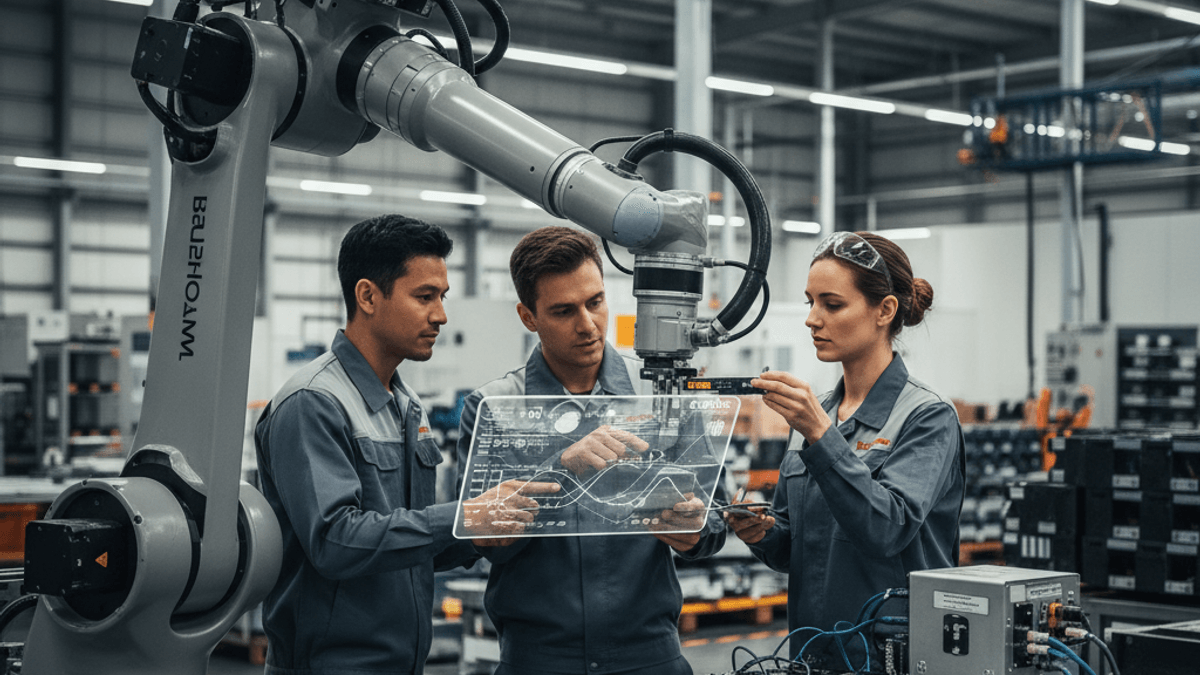
Engineers interact with an intelligent industrial robot on a factory floor.
A new report from Bain & Company highlights a significant transformation underway in the industrial automation sector, marking a fundamental shift from traditional control systems to intelligence-driven operations. The consulting firm’s analysis indicates that economic value creation is moving away from a pyramid structure, historically concentrated in control hardware, towards an hourglass model.
According to Bain, profit pools are increasingly found in software, data, artificial intelligence (AI), and smart field devices. This evolution is driven by several factors, including the erosion of legacy advantages, changing operational environments, and intensifying competition. The report suggests that future success in industrial automation will depend on the ability to orchestrate intelligence, leverage software and data as core assets, integrate smart devices into decision-making processes, and develop vertical-specific solutions.
The analysis points out that by 2030, over 80% of industry profit pools are projected to reside in software/data-driven layers (exceeding 50%) and smart field devices (25%-30%). This contrasts sharply with the previous concentration of value in control hardware and systems.
Several forces are contributing to the rapid erosion of legacy advantages. These include structural labor shortages, an aging workforce, the reconfiguration of supply chains for enhanced resilience, and escalating demands for sustainability, cybersecurity, and traceability. Furthermore, differentiation is increasingly occurring in the software and data realms, rather than solely in hardware. Competition is also intensifying, with hyperscalers, AI-native players, and aggressive hardware manufacturers challenging established incumbents.
Bain posits that the competitive edge in the future will be defined by the capacity to orchestrate intelligence, moving beyond mere technology deployment. This transition involves a shift from control logic to decision logic, enabling systems to continuously make decisions, adapt to variability, and optimize outcomes. AI is expected to initially impact high-value use cases such as adaptive robotics, predictive maintenance, and knowledge-based systems, with nearly half of industry revenues anticipated to rely on AI-enabled offerings by 2030.
Software and data are emerging as the primary drivers of value. Operations platforms, workflow applications, and AI-driven optimization tools are becoming central to industrial systems, facilitating operational convergence and enabling faster, better operational decisions through integrated data. Intelligence is also moving closer to physical processes via smart field devices, with growth increasingly concentrated in vertical-specific solutions that embed industry knowledge and regulatory requirements.
The report also notes an evolution in business models, with a greater emphasis on recurring revenues, outcome-based contracts, and lifecycle value, focusing on continuous improvement and accountability for results. Bain advises leaders to make strategic choices about where to compete, deepen vertical expertise, treat software and data as core assets, redesign commercial models for lifetime value, and reinvent their ecosystems through strategic partnerships to effectively coordinate intelligence across partners and machines.
About the Author