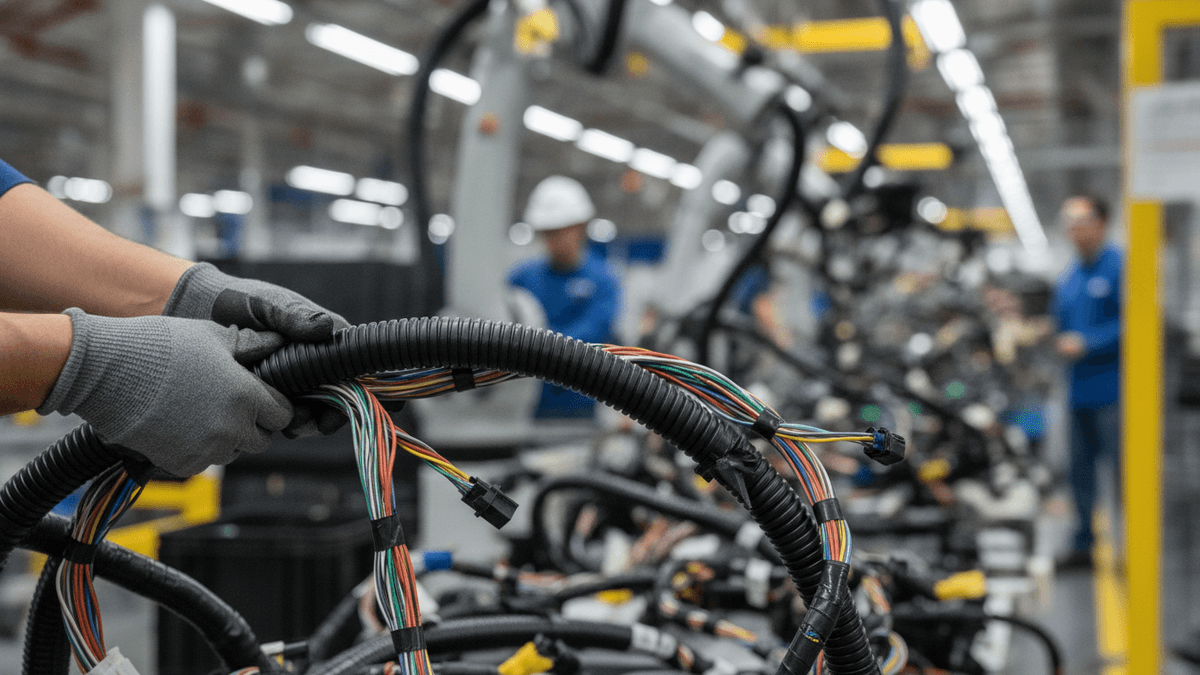
Worker installs non-expandable sleeving on automotive wiring harness in Mexico.
The non-expandable sleeving market in Mexico, a critical B2B segment supporting the nation’s manufacturing and industrial maintenance sectors, is projected to experience a Compound Annual Growth Rate (CAGR) of 5-7% between 2026 and 2035. This growth is largely attributed to the surge in nearshoring activities within the automotive, electronics, and industrial machinery industries.
Non-expandable sleeving, characterized by its fixed diameter tubular protective covers for wires, cables, hoses, and tubing, plays a vital role in shielding these components from environmental hazards such as abrasion, heat, and chemical exposure. The automotive wiring harness segment alone represents a substantial 30-35% of the domestic demand for these products.
A key feature of the Mexican market is its significant reliance on imports, with 60-70% of the supply originating from international sources, primarily the United States and China. Current market trends indicate a move towards premium materials, including PTFE and aramid fiber, alongside a growing demand for localized supply chains that can offer readily available inventory. Furthermore, there is an increasing emphasis on sustainable, halogen-free, and RoHS-compliant sleeving formulations.
Despite the robust growth prospects, the market faces challenges such as price volatility of raw materials, complex customs classifications across various Harmonized System (HS) codes, and stringent technical certification requirements like PPAP, UL, and SAE, which can extend supplier approval timelines.
Mexico’s strategic position as a manufacturing hub for North America underpins the demand for high-specification products and reliable supply chains. The market caters to both multinational original equipment manufacturers (OEMs) and smaller assembly operations, with industrial procurement being the dominant channel. While global manufacturers leverage established distributor networks, domestic converters focus on value-added services such as cutting and kitting.
The market is expected to see its value increase by 50-70% by 2035 compared to its 2026 base. The automotive sector remains a primary growth driver, with each vehicle incorporating approximately 1.5 to 3.0 kg of wire harness protection materials. The expansion of renewable energy projects is also contributing to market growth, bolstered by the advantages offered by the USMCA trade agreement.
In terms of material composition, polyester sleeving currently leads the market share at 35-40%, followed by polyolefin (20-25%) and PVC (15-20%). While premium materials like PTFE and aramid fiber hold a smaller share (5-10%), they are experiencing faster growth rates. Pricing structures vary significantly, from $0.05-$0.50 per meter for commodity grades to $2.00-$8.00 per meter for premium options. Wire harness protection and cable management applications constitute over half of the market demand, with automotive wiring being the largest end-use segment.
The competitive landscape is characterized by a mix of global manufacturers operating through distributors, regional distributors offering inventory and technical support, and local converters providing customization. The emphasis for competition lies in brand recognition, product certifications, consistency, inventory availability, lead times, and technical expertise. Domestic players often compete on local responsiveness and customization, though they may face challenges in matching the quality standards and certifications of global competitors.
Primary manufacturing of sleeving materials is limited in Mexico due to insufficient market scale for capital investment. Instead, domestic activity often focuses on downstream conversion of imported sleeving. Consequently, Mexico remains heavily import-dependent, with imports fulfilling 60-70% of domestic demand. The United States is the principal source of imports, followed by China.
Distribution channels are multi-tiered, predominantly featuring specialized industrial distributors. Direct manufacturer-to-OEM agreements also exist, particularly for larger accounts. The growing demand for specialized sleeving in sectors like aerospace and medical devices, coupled with the transition to electric vehicles and renewable energy infrastructure, presents significant opportunities for market players focused on high-performance products and localized supply chain solutions.
About the Author