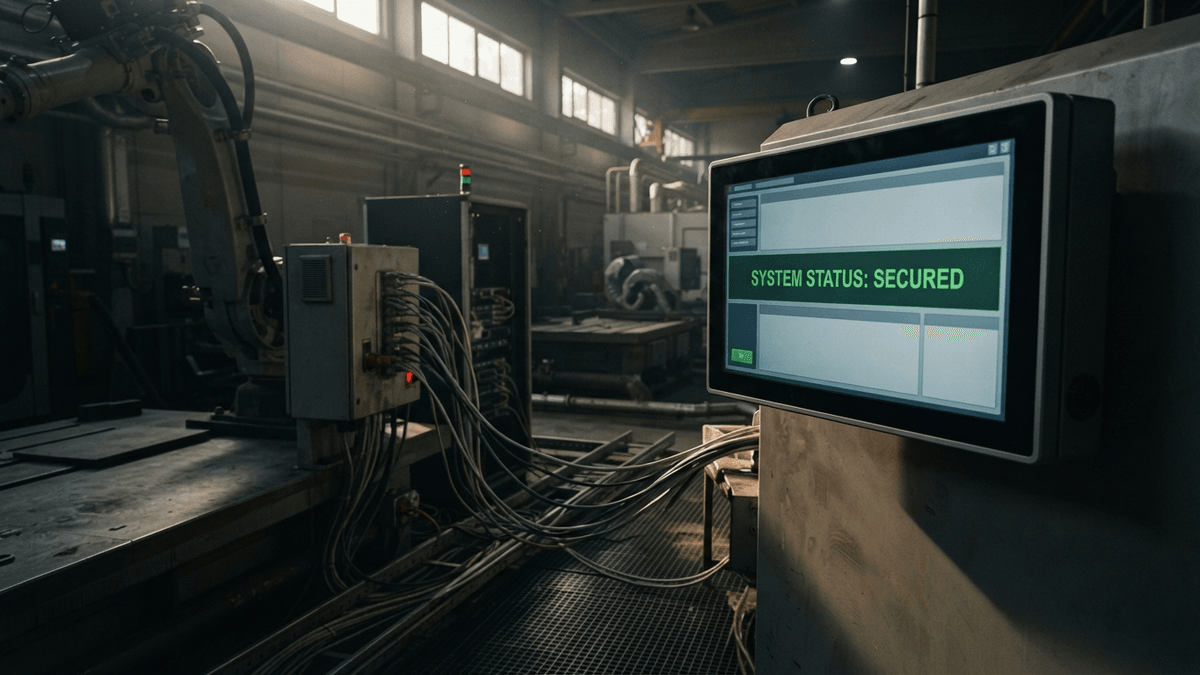
An industrial machine display indicates security status in a connected manufacturing facility.
The rapid adoption of Industry 4.0 technologies is fundamentally altering the landscape of industrial machine safety. As manufacturing facilities increasingly rely on interconnected systems to drive operational efficiency, the convergence of operational technology (OT) and information technology (IT) has introduced critical cybersecurity risks that demand immediate attention from asset managers and private equity investors.
Traditional safety protocols, which were historically air-gapped and isolated from external networks, are no longer sufficient in an era of constant data streaming and remote monitoring. This shift necessitates a comprehensive re-evaluation of how safety-critical systems are protected against unauthorized access. Failure to secure these networks does not only pose a threat to data integrity but also to physical personnel and machine longevity.
For institutional investors and private equity firms focused on the industrial sector, the transition to ‘smart’ manufacturing requires rigorous due diligence regarding cybersecurity infrastructure. Investments in digital transformation must now be balanced with investments in robust security architectures to prevent catastrophic operational downtime or safety breaches. As connectivity becomes standard, the ability to maintain regulatory compliance while protecting the integrity of industrial networks has emerged as a key value driver for manufacturing portfolio companies.
Industry experts emphasize that the integration of data-driven safety monitoring should not come at the expense of system isolation where necessary. Instead, firms must develop strategies that leverage the benefits of Industry 4.0 while implementing multi-layered security measures to mitigate the risks inherent in a hyper-connected manufacturing environment.
About the Author