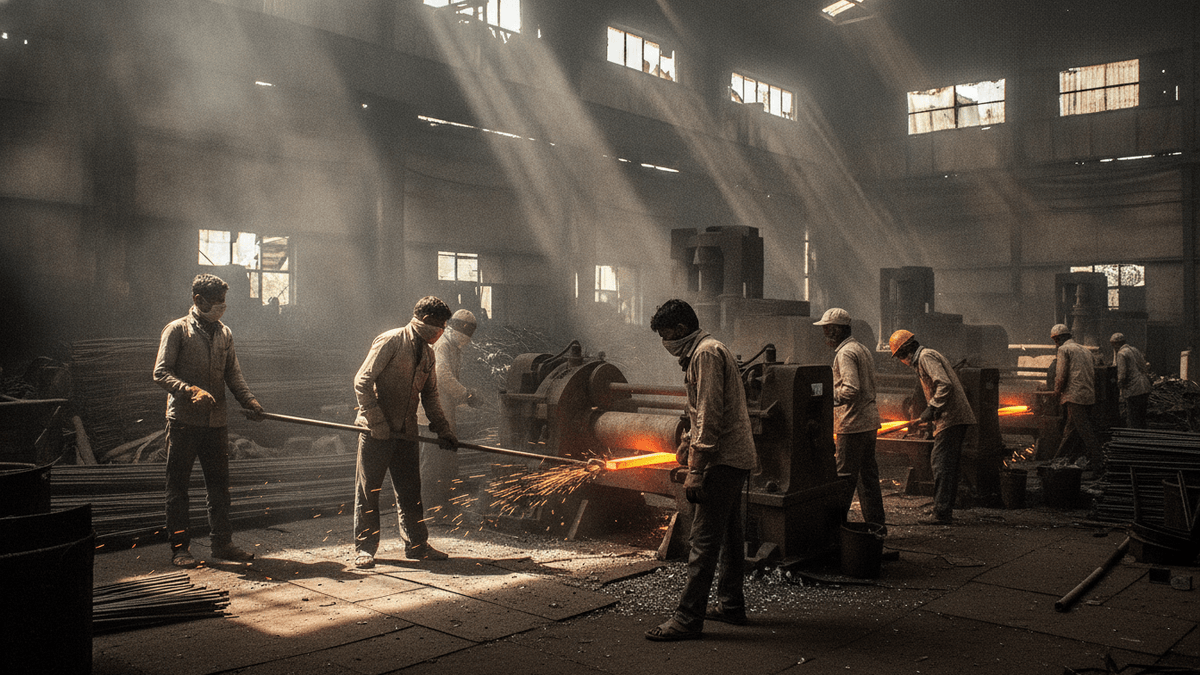
Workers in an Indian steel production facility
India, the world’s second-largest crude steel producer with an annual capacity of 220 million tonnes, faces significant structural contradictions within its steel sector. The industry operates on a bifurcated production model, comprising large primary producers such as Tata Steel, JSW Steel, and SAIL, alongside numerous decentralized secondary units that account for approximately 47% of national output. These secondary units heavily rely on unorganized, low-wage manual labor, contributing to a complex labor landscape.
The primary consumption of finished steel in India is dominated by the Building & Infrastructure sector, which accounts for 60-65% of demand. Other significant sectors include Capital Goods, Automotive, Energy, and Railways & Defence.
Despite possessing substantial domestic raw material reserves, India has become a net importer of finished steel. The country imports high-value flat steel products from nations like South Korea, Japan, and China, while exporting lower-margin commodity products. This imbalance results in an annual trade deficit exceeding ₹9,000 crore and highlights India’s reliance on foreign technological expertise for specialized metallurgy.
A critical issue within the industry is the political economy of labor, marked by frequent industrial accidents and exploitation. Worker mortality is often viewed as an acceptable overhead cost, exacerbated by a two-tiered labor structure that compromises plant safety. Incidents like the 2018 disaster at SAIL’s Bhilai Steel Plant and a 2026 explosion at the Visakhapatnam Steel Plant, where numerous contract laborers lost their lives due to ignored safety protocols, underscore these hazardous working conditions. In the unorganized secondary sector, informal labor bears the brunt of price volatility through accelerated shift rhythms, compromised safety measures, and unrecorded injuries.
Furthermore, India’s steel industry is vulnerable due to its significant dependence on imported high-grade metallurgical coking coal, with over 70% sourced from Australia and Russia. This reliance exposes the domestic value chain to external price fluctuations. The extraction of iron ore from forest regions also leads to the displacement of indigenous communities.
In conclusion, while the expansion and integration of India’s steel industry into global supply chains foster international relations and trade, these developments are built upon deep structural contradictions, significant human costs, and considerable ecological impact.
About the Author