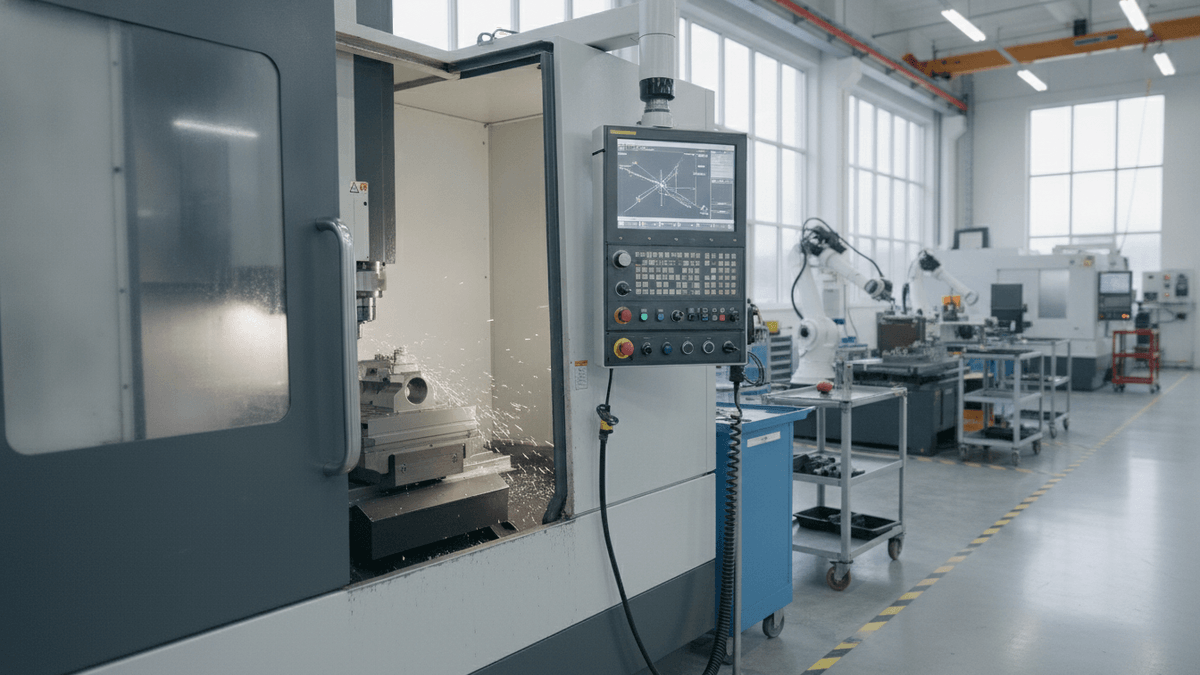
Multi-axis machining center processing a metal component in a factory.
Stocks of industrial companies DMG Mori, SKF, and Sulzer are demonstrating resilience, underpinned by strong earnings, substantial order backlogs, and a strategic focus on improving margins. DMG Mori reported approximately JPY 500 billion in revenue for fiscal year 2024, driven by demand for advanced machine tools and automation, with a transition towards higher-margin digital technologies and lifecycle services. SKF, a global supplier of bearings and seals, saw net sales growth in fiscal 2025, benefiting from pricing and productivity, despite input cost increases and currency fluctuations. Its industrial segment, particularly in renewable energy, is a key growth driver, supported by a significant order backlog. Sulzer reported group revenues of approximately CHF 3.3 billion, with improved operational EBIT margins in its flow equipment division and positive order intake, driven by engineered pumps and aftermarket services. All three companies maintain robust cash generation, stable balance sheets, and manageable debt levels, with dividend policies reflecting their financial strength. Investor sentiment for these stocks is shaped by their solid fundamentals, operational indicators, and broader industrial market trends, including sensitivity to manufacturing cycles and currency movements.
DMG Mori’s stock performance is underpinned by consistent earnings, a robust order backlog, and strategic investments in advanced machine tools and automation. For fiscal year 2024, the company reported annual revenue of approximately JPY 500 billion, reflecting its significant position in the global machine tool and automation market. This revenue growth is supported by demand from key sectors such as automotive, aerospace, medical, and general engineering, which are continuously upgrading to more automated and digitally connected machinery. The company is strategically transforming its business model towards higher-margin solutions, including integrated automation, software, and lifecycle services, which enhance earnings resilience even during slower capital equipment cycles.
Operating profit and net income figures are consistent with a machine-tool manufacturer navigating a cyclical environment. The operating margin, while not as high as purely software-driven industrial players, is notably better than traditional hardware-focused builders in past downturns, thanks to the contribution of software and services. Following pandemic-related disruptions, both revenue and earnings have recovered to levels exceeding those of the early 2020s, driven by resurgent capital spending and factory modernization efforts. This recovery has enabled DMG Mori to restore and, in some cases, increase its dividend distributions, signaling management’s confidence in the company’s cash-generation capacity and sustainable earnings.
DMG Mori’s core business involves designing, manufacturing, and selling metal-cutting machine tools, such as CNC turning centers and multi-axis machining centers. These are complemented by automation modules and digital technologies for machine monitoring and connectivity, aligning with Industry 4.0 initiatives. The company has also invested in additive manufacturing and hybrid machines, positioning itself in high-growth niches that demand complex geometries and rapid prototyping. These high-technology segments are expected to yield higher margins and deepen customer relationships over time.
For equity investors, DMG Mori stock reflects both its fundamental performance and broader economic indicators like global manufacturing PMI readings and investment cycles. The shares typically trade within a range characteristic of established Japanese capital-goods manufacturers. The company benefits from geographic diversification, serving customers across Europe, the Americas, and Asia, which helps mitigate dependence on any single economy. From a financial perspective, DMG Mori maintains a stable balance sheet with managed net debt levels, supporting ongoing investments and dividend payments, making it a core holding for some investors in the machine-tool segment. Its high-precision machining centers are a representative product, known for their speed, accuracy, and multi-axis capabilities, crucial for customers in automotive and aerospace supply chains.
About the Author