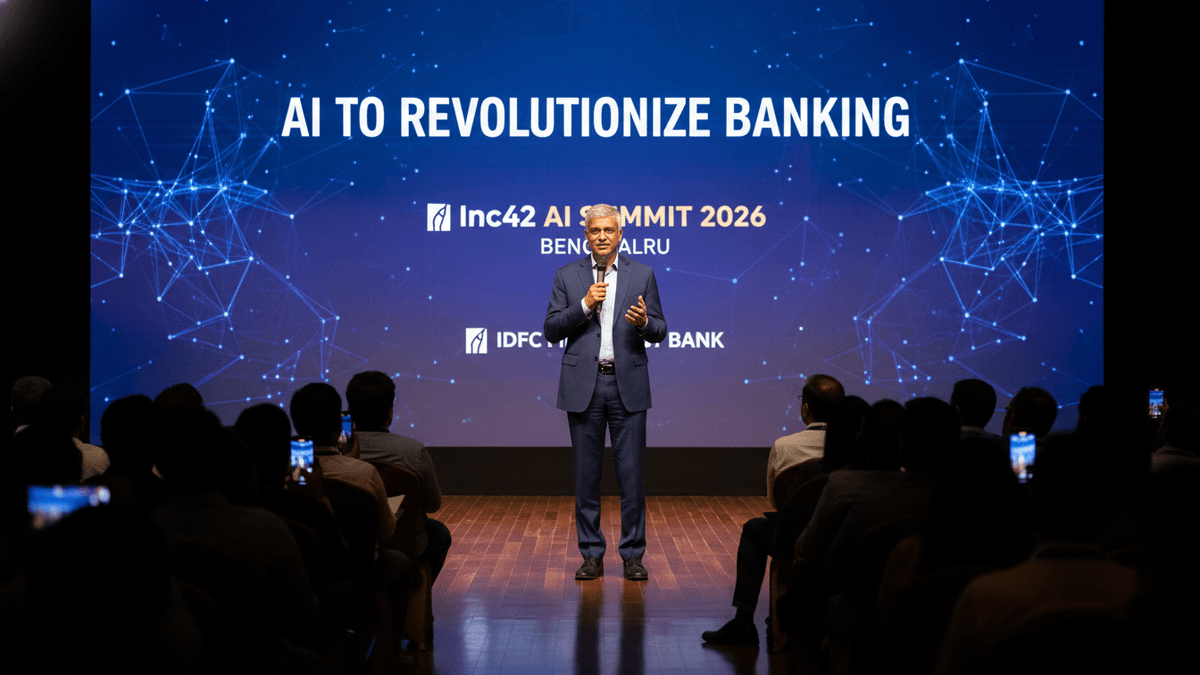
V Vaidyanathan presenting at Inc42 AI Summit 2026
V Vaidyanathan, MD and CEO of IDFC FIRST Bank, has articulated a vision for the future of banking, one where Artificial Intelligence (AI) will shift the paradigm from reactive service to proactive, predictive engagement. Speaking at Inc42’s AI Summit 2026 in Bengaluru, Vaidyanathan highlighted how AI’s ability to understand, predict, and act on customer needs before they arise will define the next phase of the financial industry.
The banking sector, traditionally data-rich but often challenged by unstructured data, stands to gain significantly from an AI-first approach. Vaidyanathan emphasized that a bank capable of effectively leveraging its data through AI could emerge as a leader. He pointed to IDFC FIRST Bank’s own growth trajectory, with customer deposits reaching ₹2.84 Lakh Cr in FY26, a substantial increase from ₹38,400 Cr in FY20, attributing this success to a foundational tech-first culture.
“Our magic carpet is technology. If we had gone the traditional way, we would not be anywhere close to the growth we have seen in the past seven years,” Vaidyanathan stated, underscoring the transformative impact of technology adoption.
The predictive capabilities of AI, according to Vaidyanathan, will allow banks to anticipate and resolve customer issues before they necessitate contact. An example provided was a scenario where a declined international card transaction could be preemptively addressed by the system, perhaps by prompting the customer to enable international payments or by proactively informing them of potential issues.
Furthermore, Vaidyanathan sees AI as a critical enabler of financial inclusion in India, particularly for individuals lacking formal credit histories. While cashflow-based lending has historically aided informal workers, generative AI’s capacity to analyze behavioral and transactional patterns offers deeper insights for underwriting and personalized financial services.
IDFC FIRST Bank has been integrating AI for approximately 15 years, with a more recent focus on Generative AI (GenAI) over the past two to three years. Current applications include document intelligence systems for classification and analysis, alongside internal LLM-powered knowledge assistants that draw from the bank’s standard operating procedures, policies, and regulations.
About the Author