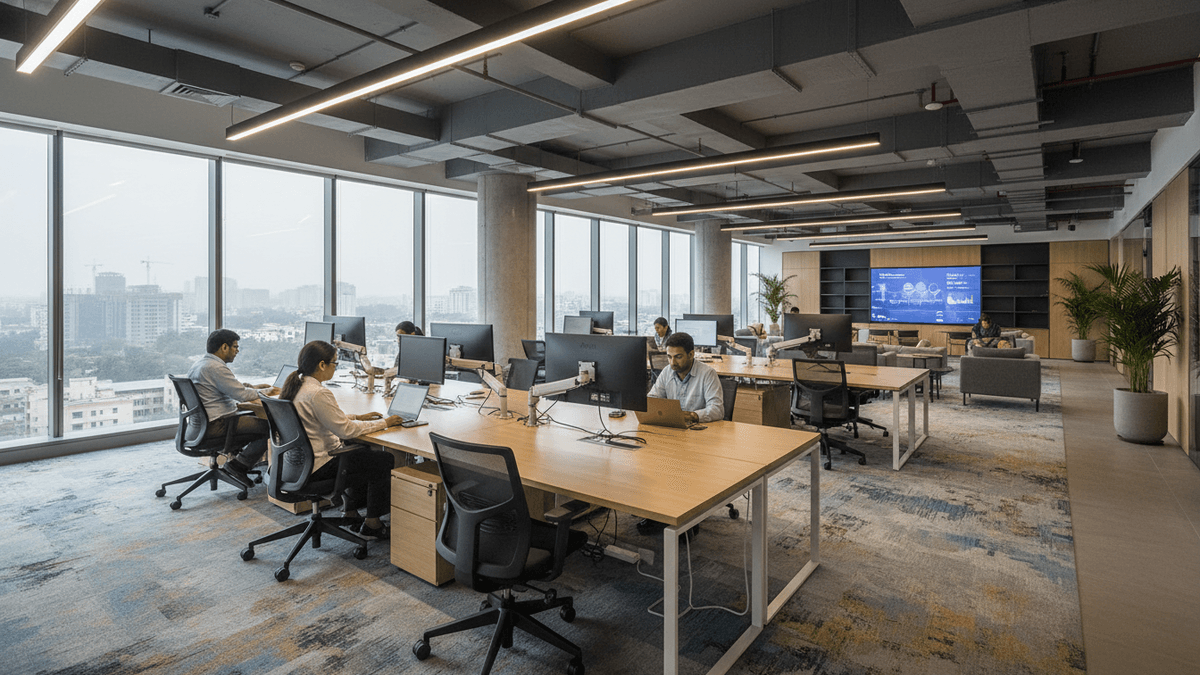
Modern coworking space with people working at desks and city visible outside windows
Awfis, India’s first new-age coworking space provider to list on the stock exchange, is strategically shifting towards premiumization to capitalize on the burgeoning demand from Global Capability Centers (GCCs). The company reported a significant increase in profitability in Q4 FY26, with net profit more than doubling year-on-year to ₹23.2 crore and operating revenue growing 20% to ₹410.1 crore. This growth is largely attributed to strong GCC demand and a focus on higher-quality, premium office spaces.
The company’s traditional managed aggregation (MA) model, which involves leasing properties and operating them as managed workspaces with revenue sharing, has historically focused on the affordable segment. However, the evolving landscape, driven by GCCs seeking sophisticated infrastructure and compliance, necessitates a pivot. India’s GCC ecosystem is now the world’s largest, with over 2,100 centers generating close to $100 billion in revenue, according to Nasscom-Zinnov. These centers are increasingly becoming crucial hubs for technology, product support, and core business functions, driving demand for flexible workspace solutions.
In response, Awfis is doubling down on securing Grade A institutional supply. Over 60% of its new supply signed in FY26 came from institutional landlords, and all new centers launched during the year were located in Grade A or A+ assets. CEO Amit Ramani highlighted that global enterprises and GCCs prioritize asset quality, compliance, and global benchmark standards. Awfis is scaling its premium Elite and Gold center formats, now operating 35 premium centers, and increasing the average size of its new centers by 20% compared to its legacy portfolio. Facilities with over 500 seats now constitute 37% of its portfolio.
To secure prime locations, Awfis is employing strategic tools like forward leasing for under-construction Grade A properties and developing a new developer partnership model where institutional developers share capital expenditure costs. The company is also optimizing its supply additions through a Partial Managed Office model, launching new properties only when 40-70% of seats are pre-anchored by enterprise or GCC clients. This approach compresses occupancy ramp-up, improves revenue visibility, and mitigates economic risks.
GCC clients currently represent 23% of Awfis’ rental revenue, with over 100 GCC clients onboarded. Despite intensifying competition from rivals like WeWork India, Smartworks, and Table Space, Awfis’ strategic premiumization and focus on institutional supply position it to capture a significant share of the expanding GCC market.
About the Author