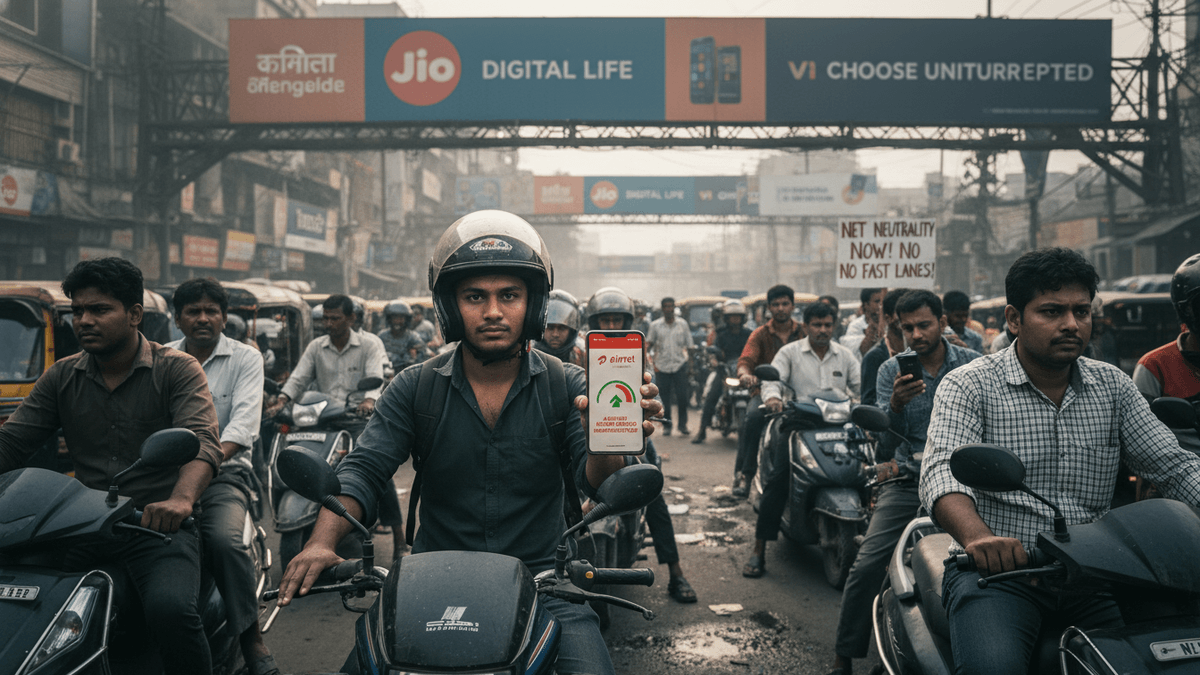
Protester on motorcycle holds phone displaying "net neutrality" message on crowded Indian street.
Airtel, India’s second-largest telecom operator, has found itself at the center of a net neutrality debate following the launch of its new “Priority Postpaid” plans. The service, which utilizes 5G standalone network slicing, promises premium subscribers enhanced data speeds and consistent connectivity, even in congested areas. This move has sparked concerns among consumer advocates and digital rights activists, who question whether it undermines the core principles of net neutrality.
The Priority Postpaid plans, ranging from ₹449 to ₹1,749 per month, are designed to offer dedicated bandwidth and guaranteed quality of service (QoS) through network slicing. This technology divides a single physical network into multiple virtual ‘slices,’ each optimized for specific user needs. While Airtel asserts that the offering is compliant with net neutrality rules, critics argue that it creates a tiered internet experience, potentially leading to a ‘fast lane’ for premium customers and a ‘second-class service’ for the majority of prepaid users.
This controversy is not new for Airtel. In 2015, the company faced significant backlash over its “Airtel Zero” platform, which was perceived as a violation of net neutrality and was eventually discontinued. The current debate centers on whether 5G network slicing, by allocating differentiated network quality based on subscription tiers, constitutes a form of discrimination that contradicts the principle of equal treatment for all internet traffic.
Experts are divided on the issue. Some, like Apar Gupta of the Internet Freedom Foundation, believe that prioritizing voice allocation to certain subscribers does not violate net neutrality. Similarly, Nikhil Pahwa of MediaNama notes that while 5G is capable of network slicing, it should not be used to discriminate between apps, services, or sectors based on speed or pricing. However, he also emphasized the importance of the Telecom Regulatory Authority of India (TRAI) examining the plan to ensure it does not degrade the experience for other users.
Telecom expert Parag Kar expressed concerns that prepaid users might face congestion if priority postpaid users heavily utilize the allocated capacity. He argued that such offerings could violate TRAI rules that mandate specialized services must not negatively impact general internet services, potentially shifting the internet from neutral access to tiered-quality access.
Airtel defended its position before a Telecom Department (DoT) panel, stating that the Priority Postpaid service does not involve blocking, throttling, or app-specific prioritization. The company highlighted that postpaid traffic constitutes a small percentage of its overall mobile traffic and that similar tiered services are offered in other countries. Airtel also argued that restricting network slicing could hinder the development of advanced technologies like 6G and industrial IoT.
Rival operator Vi launched a digital campaign critical of Airtel’s move, advocating for equal network access for all. However, Reliance Jio expressed support for Airtel, submitting to the Parliamentary standing committee that 5G network slicing is compatible with India’s net neutrality framework, provided there is no degradation of regular internet services. The telecom department and the Parliamentary panel are expected to deliberate further on the matter.
About the Author