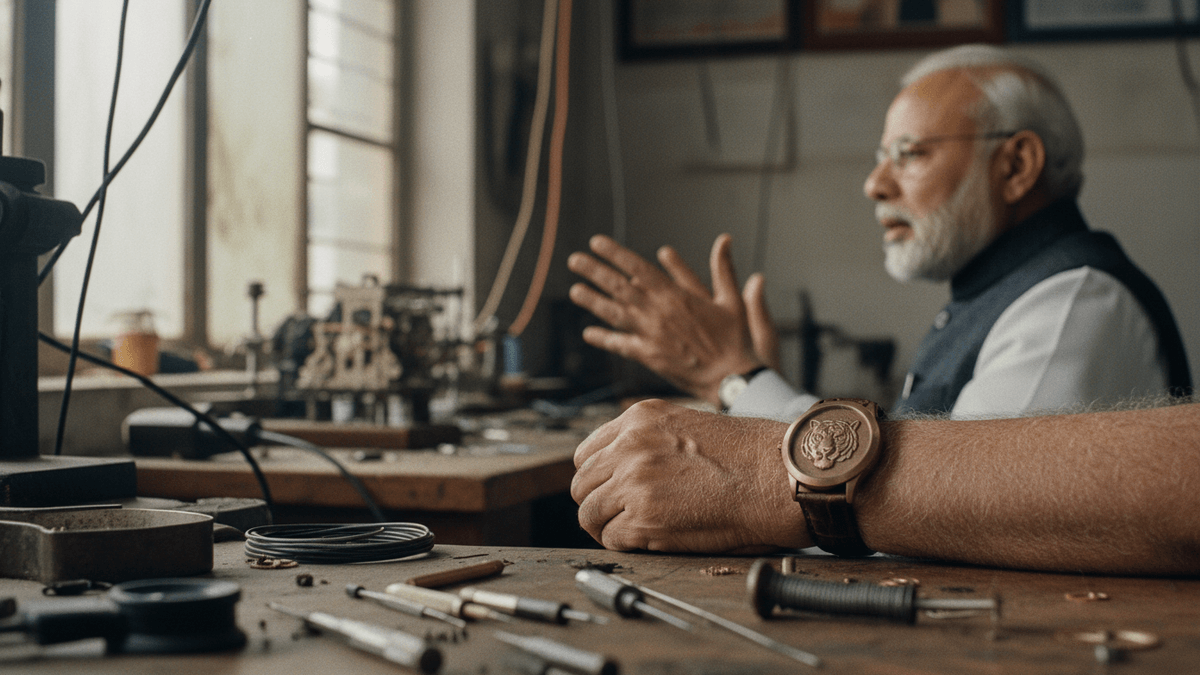
An Indian watchmaker presents a unique timepiece.
In a significant shift within India’s luxury goods market, homegrown watch brands are increasingly challenging the long-standing dominance of Swiss manufacturers. Companies like Jaipur Watch Company, Rotoris, and Bangalore Watch Company are not just competing on price but are leveraging unique Indian heritage, intricate craftsmanship, and compelling brand storytelling to capture the attention of discerning consumers.
Historically, aspirational Indian consumers have gravitated towards established Swiss luxury brands such as Rolex, Omega, and Tag Heuer. However, a new wave of direct-to-consumer (D2C) brands is filling a crucial gap in the market for style-conscious buyers seeking premium design and mechanical precision without the prohibitive costs or the ‘imported is better’ perception.
This burgeoning sector has not gone unnoticed by investors. Rotoris, founded by Aakash Anand, recently secured $3 million in funding from notable investors including Nikhil Kamath of Zerodha and actor Vivek Oberoi. Jaipur Watch Company also raised ₹2.4 crore in an angel funding round, attracting investors like Tushar Kapoor and partnering with entities such as JSW MG Motor India. Argos Watches, a more recent entrant, reported significant revenue and secured funding at a substantial valuation.
These Indian brands are differentiating themselves by focusing on elements that global luxury houses cannot easily replicate. Gaurav Mehta, CEO and founder of Jaipur Watch Company, emphasizes competing on originality, storytelling, craftsmanship, and emotional connection. He highlights the strategic advantage of incorporating Indian artistic heritage, such as coin artistry, miniature painting, and textile-inspired detailing, into their designs.
The strategy appears to be resonating with consumers, particularly in the ‘accessible luxury’ segment, typically priced between ₹15,000 and ₹50,000. These brands offer features like sapphire glass and mechanical movements, providing a compelling alternative to entry-level Swiss offerings. This segment is seen as a crucial stepping stone for consumers who aspire to own high-end luxury watches like Rolex in the future.
While challenges remain, including building long-term customer loyalty and overcoming potential ‘graduation’ to ultra-luxury brands, the ecosystem is maturing. The demand for premium watches is extending beyond major metropolitan areas, with a significant portion of luxury purchases now originating from non-metro cities. This indicates a widespread aspiration for quality and craftsmanship across India, positioning these new-age Indian watch brands for sustained growth and a permanent place in the collector’s market.
About the Author