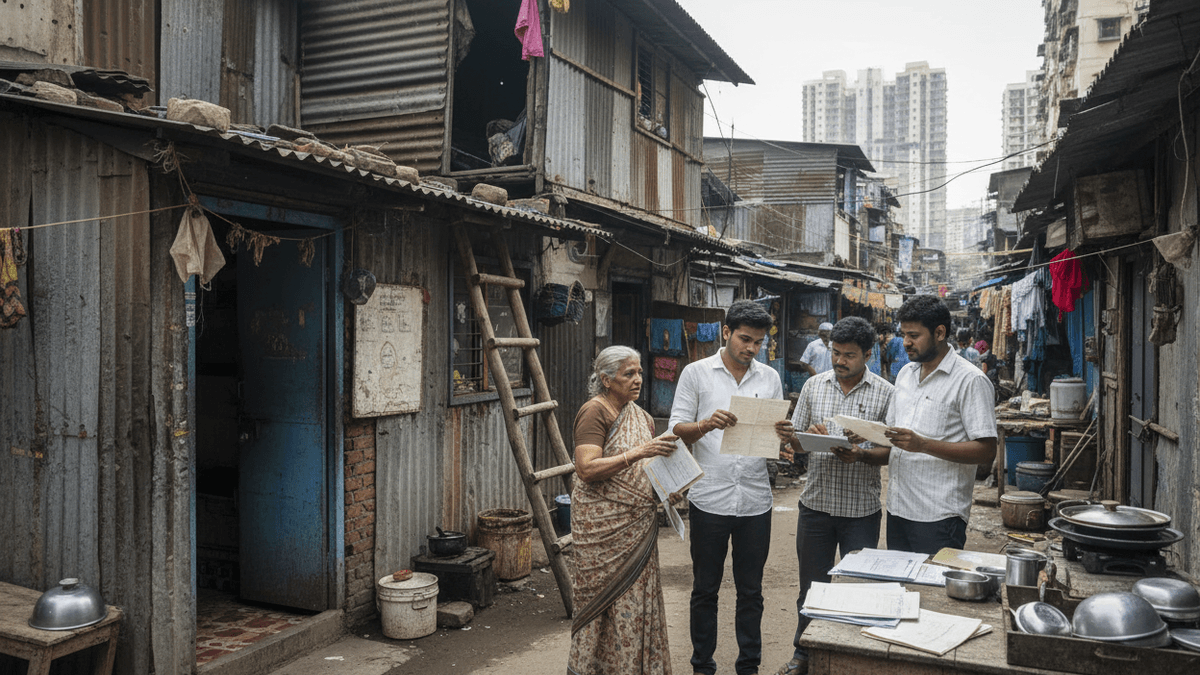
Residents in Dharavi discussing redevelopment documents with officials.
MUMBAI – A new directive from the Maharashtra government has introduced a complex layer to the highly anticipated Dharavi redevelopment project, potentially impacting the eligibility of upper-floor residents for new housing. Under a recent government resolution, the rehabilitation of individuals residing on upper floors is now contingent upon the eligibility of the ground-floor occupant.
This marks a significant shift, as it is the first time upper-floor residents are being considered for such rehabilitation schemes. To qualify for the 300 sq ft homes offered within the Mumbai Metropolitan Region, residents must provide proof of occupancy prior to November 15, 2022. However, the new resolution stipulates that the ground-floor tenant’s qualification is a prerequisite for the upper-floor resident’s own eligibility.
The Dharavi redevelopment project, one of Asia’s largest urban renewal initiatives, aims to transform the densely populated slum into a modern urban district. The inclusion of upper-floor residents represents an expansion of the scheme’s scope, but the dependency on ground-floor occupants introduces a new administrative and logistical challenge. The resolution, issued by the Maharashtra government, seeks to streamline the process while ensuring a clear chain of occupancy verification.
Details regarding the specific criteria for ground-floor occupants and the mechanisms for verifying this dependency remain critical for understanding the full implications for thousands of residents. The success and timeline of the broader Dharavi redevelopment are closely watched, with this new eligibility clause adding a layer of complexity to the already ambitious project.
About the Author