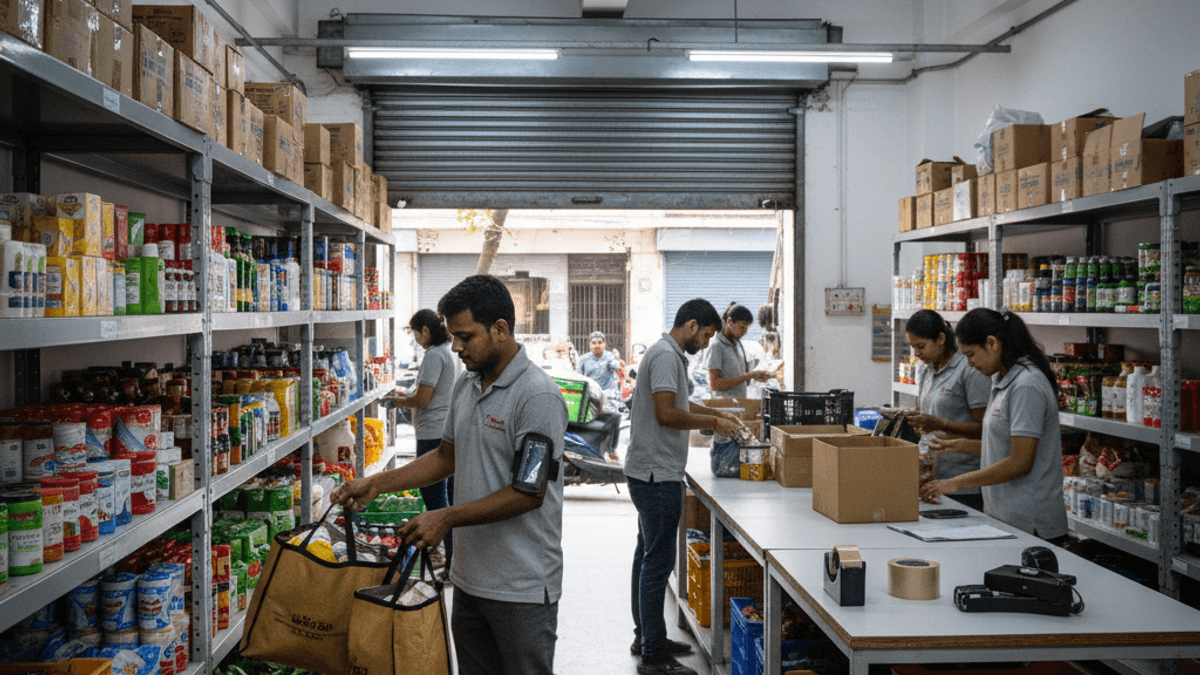
Workers in a micro-fulfillment center in India, actively preparing quick commerce orders for dispatch.
Amazon India is set to significantly expand its quick commerce service, ‘Amazon Now,’ aiming to reach 100 cities across the country. This strategic move is underpinned by a substantial investment aimed at bolstering the e-commerce giant’s presence in India’s rapidly growing rapid delivery market.
The expansion plan involves scaling its fulfillment infrastructure to over 1,000 micro-fulfillment centers (MFCs), a move designed to facilitate the delivery of daily essentials within minutes. Currently operational in Bengaluru, Delhi NCR, and Mumbai, Amazon Now will progressively roll out to other major metropolitan and non-metropolitan areas, including Pune, Hyderabad, Chennai, and Kolkata, among others.
Harsh Goyal, vice president of everyday essentials at Amazon India, highlighted that the accelerated expansion is expected to empower more than 16,000 farmers by enabling them to leverage Amazon’s technology and operations to connect directly with consumers through sellers on Amazon Now.
Amazon Now offers a diverse product range, encompassing groceries, personal care items, fashion and beauty products, small appliances, baby supplies, pet food, and healthcare supplements. This expansion is a component of Amazon India’s recently announced ₹2,800 crore (approximately $300 million) investment, a significant portion of which is earmarked for strengthening its quick commerce operations and doubling its footprint in the segment.
The company currently operates around 300 MFCs in its existing markets and plans to more than double this number by the end of 2026. This initiative follows previous investments, including a ₹2,000 crore allocation that enhanced its logistics network with new fulfillment centers, sortation centers, and last-mile delivery stations. Amazon has also committed to investing $35 billion in India by 2030 to boost exports.
Launched in Bengaluru in June 2025, Amazon Now expanded to Delhi and Mumbai shortly thereafter. This broader rollout positions Amazon to compete more intensely with established quick commerce players like Blinkit, Zepto, and Swiggy Instamart, as well as rivals such as Flipkart Minutes and Reliance’s JioMart.
The quick commerce sector in India is projected to become a $40 billion market by 2030, underscoring the strategic importance of Amazon’s investment and expansion efforts in this segment.
About the Author