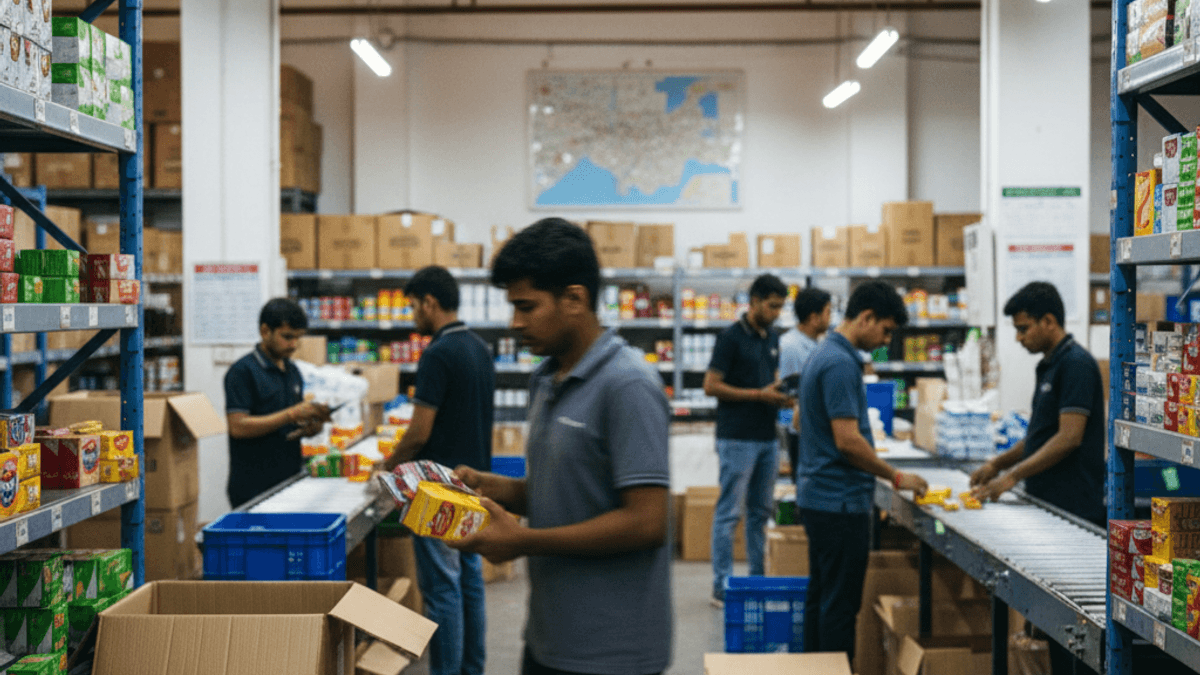
Warehouse workers fulfilling orders in a busy Indian quick commerce fulfillment center.
India’s B2B e-commerce landscape is rapidly transforming, moving from a fragmented, kirana-led system to a digitised supply chain driven by technology. The emergence of quick commerce platforms has accelerated this evolution, shifting the industry’s focus from efficient distribution to rapid fulfillment, with delivery expectations now centering on same-day and even sub-two-hour timelines.
In response, ElasticRun, an Indian unicorn, is reworking its strategy by pivoting towards enabling Direct-to-Consumer (D2C) quick commerce. Founded in 2016 by Sandeep Deshmukh, Saurabh Nigam, and Shitiz Bansal, the company initially established its thesis around connecting brands with rural consumers through a tech-led distribution network. Operating within India’s $60 billion B2B e-commerce market, ElasticRun aimed to solve supply chain inefficiencies and expand market reach for FMCG companies.
The company is now positioning its extensive network as a plug-and-play infrastructure layer. Brands can place inventory across ElasticRun’s distributed fulfillment centers, with the company managing backend operations, order allocation, picking, shipping, and last-mile deliveries. This strategic shift is already evident in ElasticRun’s operational metrics, which now handle close to 5 million orders daily, with recent volume growth largely attributed to the demand for faster fulfillment.
“The biggest inflexion came last year as everyone shifted towards fast fulfillment. While traditional models still exist, there are very few large-scale partners available for same-day or two-hour delivery,” stated Deshmukh, highlighting a market gap ElasticRun aims to address.
To support this transition, ElasticRun is repurposing its network across over 500 cities, supported by more than 900 delivery stations and approximately 100 fulfillment centers. The company has observed a significant increase in its customer mix, with a growing number of D2C brands onboarded in recent months, indicating a strategic move towards regional brands with improved unit economics.
ElasticRun’s pivot to D2C is driven by market demand and a strategic shift in its operating model. While traditional FMCG and enterprise clients offer stable demand, D2C brands present higher volatility but also significantly higher growth potential. Deshmukh noted, “D2C brands can help multiply sales within a quarter or a year, which makes them a strong driver of incremental volumes and network utilization.”
The engagement model with D2C brands differs from that with established FMCG players. ElasticRun is moving towards a fulfillment-first model, avoiding inventory risk and concentrating on execution efficiency. “Our fulfillment network is available… you deploy your inventory into our fulfillment centers, and from that point onward, we handle everything — order allocation, picking, shipping, and delivery,” Deshmukh explained. This approach is described as structurally lighter on working capital, more scalable, and increasingly attractive from a margin perspective, enhancing network utilization and driving operating leverage.
Historically, ElasticRun’s strategy involved building a nationwide logistics backbone by tapping into underutilized assets such as warehouses, vehicle time, and part-time workforce, thus avoiding heavy upfront capital expenditure. This model offers asset owners a way to monetize idle capacity while providing brands access to a scalable distribution network without significant upfront costs. The company’s variable model also allows for flexible scaling of capacity, aligning costs with actual usage and enhancing both cost efficiency and operational flexibility.
ElasticRun’s growth can be segmented into three phases: initially focusing on deep rural markets, then expanding to support FMCG companies’ rural distribution, and currently navigating the rise of quick commerce. The company is converting delivery stations into fulfillment centers, enabling both storage and delivery from a single node to support faster deliveries.
Despite the opportunity in quick commerce, ElasticRun faces scrutiny regarding its execution track record, with industry sources citing challenges in service consistency. However, Deshmukh disputes these claims, stating that the company has not lost any enterprise or large clients and has seen its client base expand, particularly with D2C brands. He maintains that performance on reliability and delivery quality remains strong, with significant volume growth achieved while maintaining on-time delivery and order accuracy. The company also highlights a strong Net Promoter Score (NPS) and repeat rate among brand partners.
The competitive landscape remains intense, with players like Shadowfax and Delhivery expanding aggressively, alongside specialized quick commerce logistics providers. ElasticRun is reportedly working to increase its market share in this segment.
Looking ahead, ElasticRun is focusing on metro markets and plans to expand its reach to the top 200 cities by FY27 and cover all 500 cities by FY28. Expansion is expected to come from increasing capacity within existing markets rather than entering new geographies. The company aims to build a full-spectrum fulfillment network, offering delivery timelines ranging from 30 minutes to next-day, depending on brand requirements and inventory placement.
ElasticRun’s FY26 was characterized by a significant shift towards D2C brands, which have become the fastest-growing segment in its portfolio. The company anticipates that same-day delivery will become a standard offering in FY27. This evolution presents both an opportunity for higher growth potential and a test of ElasticRun’s service reliability and execution capabilities in a market increasingly defined by vertically integrated quick commerce platforms.
About the Author