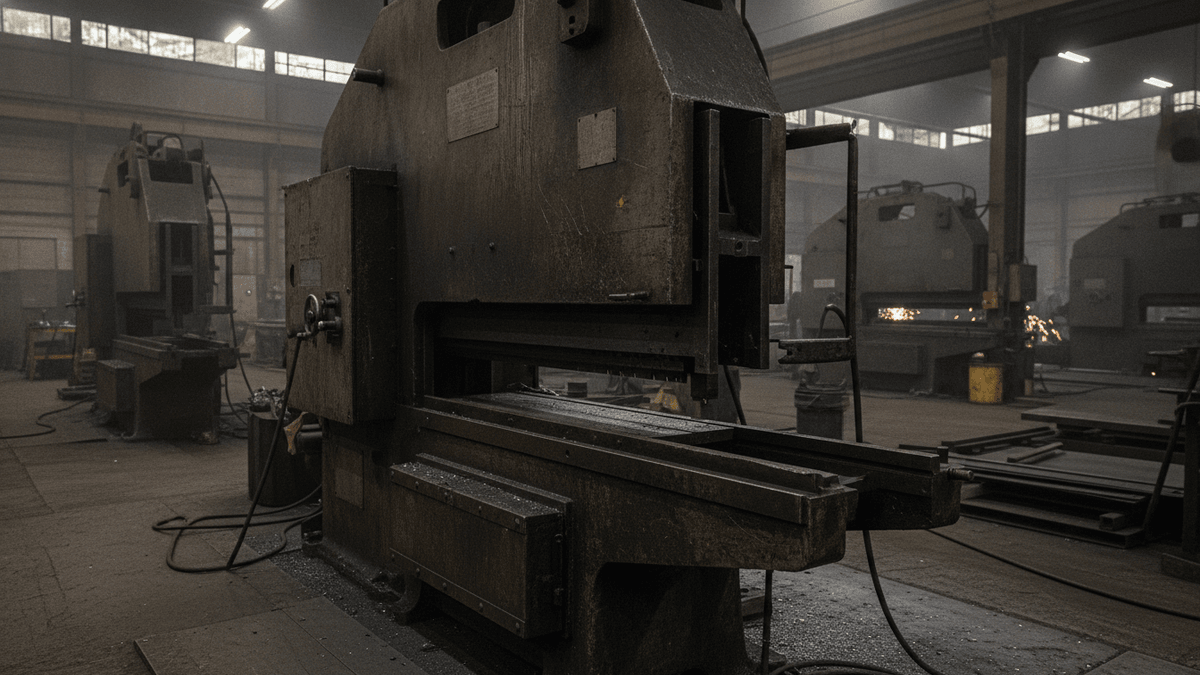
Industrial guillotine machine with a removed safety guard on a factory floor.
A series of fatal industrial accidents across the UK, India, Canada, and the US has triggered intensified enforcement by regulators, resulting in substantial fines and ongoing criminal investigations. These incidents, primarily attributed to inadequate machinery guarding and safety protocol failures, underscore a global trend of increased scrutiny on industrial and construction firms.
In the UK, Bertschi Ltd was fined £425,000 following the death of a warehouse supervisor who fell from an unguarded mobile ramp. The Health and Safety Executive (HSE) highlighted a failure to conduct adequate risk assessments. Similarly, in Canada, Mounce Construction Ltd faced an $11,613 fine after a worker was killed by an excavator boom, a consequence of an unengaged hydraulic lockout and a lack of established safe work procedures.
The printing and metalworking sectors have also seen significant penalties. Howard Hunts (City) Ltd incurred a £15,400 fine after an employee suffered a severe hand injury on a printing press with removed safety guards. In a more severe case, a sheet metal company was fined $300,000 when a 17-year-old apprentice lost seven fingers operating a guillotine with a bypassed safety guard and absent pre-start checks.
Beyond mechanical failures, toxic exposures remain a critical concern. Two employees died at the Woodland Pulp mill in Maine in January 2026 due to a hydrogen sulfide gas leak, with investigations pointing to the absence of essential gas detection systems. These incidents, alongside others like a construction worker’s impalement in Lucknow and a fatal fire at a firecracker factory in Ahmedabad, are driving renewed demands for enhanced safety standards, the adoption of automated solutions, and more rigorous regulatory oversight in industrial and construction environments.
About the Author