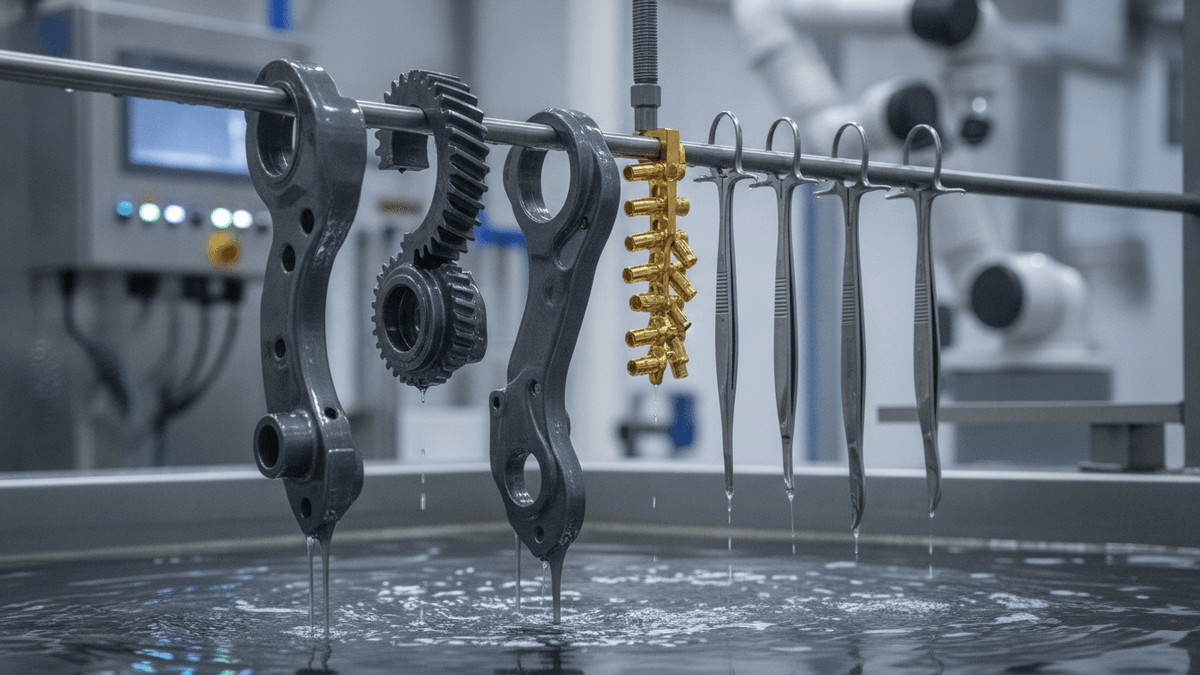
Electroplating industrial components at a European manufacturing facility
The European electroplating market is on track to achieve significant growth, with projections indicating it will reach USD 9.57 billion by 2035. This represents a substantial increase from USD 6.01 billion in 2025, with a projected Compound Annual Growth Rate (CAGR) of 4.76% between 2026 and 2035. This expansion is largely attributed to sustained demand from critical industries including automotive, aerospace, medical devices, and electronics, as well as a growing fashion and accessories sector.
Electroplating plays a vital role in Europe’s advanced manufacturing landscape, offering essential protective qualities against wear, friction, and corrosion for components, thereby enhancing their durability. For the medical sector, it ensures biocompatibility and facilitates sterilization of instruments.
In terms of specific processes, rack plating held the largest market share at 34.10% in 2025, followed by barrel plating (27.80%), continuous plating (21.60%), and line plating (16.50%). Zinc emerged as the dominant metal in 2025, capturing a 21.80% share due to its cost-effective corrosion resistance. Nickel and chromium also maintained significant positions in the market.
The automotive industry stands out as the primary end-use sector, accounting for 31.20% of the market in 2025. This dominance is fueled by the ongoing need for superior corrosion resistance and premium finishes, particularly in luxury vehicle manufacturing. The electrical and electronics sector is another key driver, leveraging electroplating for the miniaturization, conductivity, and reliability of its components.
Key players in this competitive market include Atotech, MacDermid Enthone Industrial Solutions, Dr.-Ing. Max Schlötter GmbH & Co. KG, Umicore, and LEGOR Group. These companies are increasingly focusing on developing sustainable chemical solutions and ensuring compliance with the European Union’s stringent environmental regulations.
About the Author