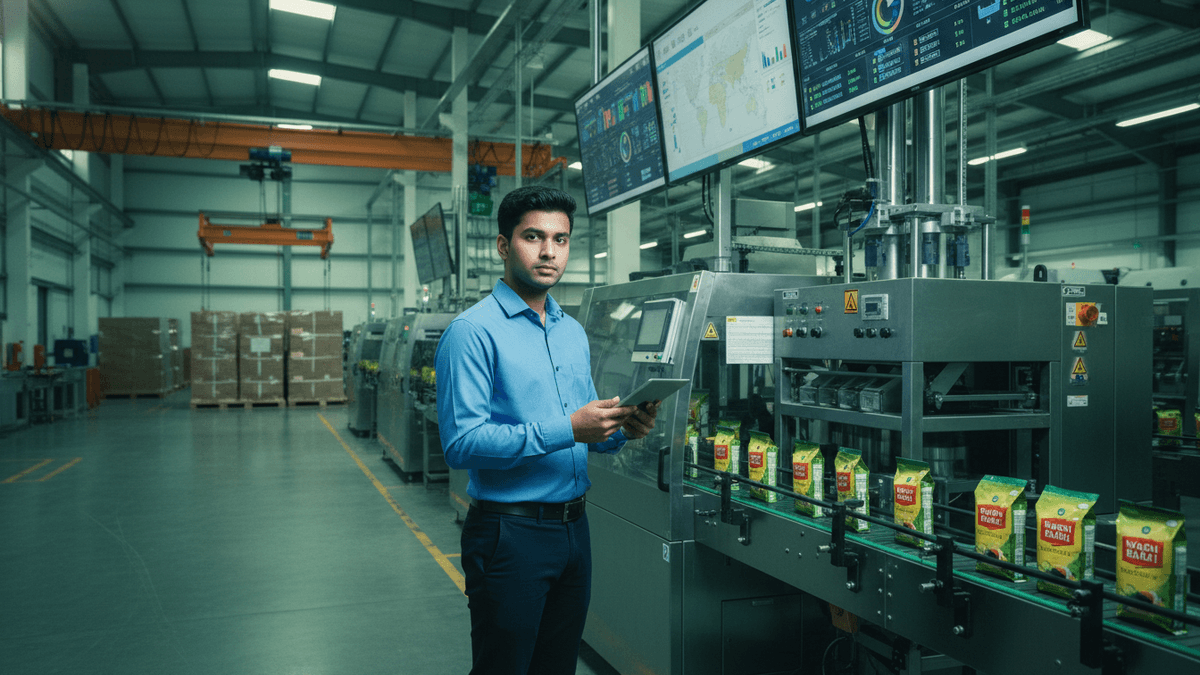
Young manager with tablet in a modern tea packaging facility
The Wagh Bakri Tea Group, a venerable Indian brand established in 1919, has embarked on a significant digital transformation, spearheaded by its fifth-generation leadership. In 2016, the company began integrating online channels to complement its robust offline distribution network, a move critical for adapting to evolving consumer behaviors and market dynamics.
Priyam Parikh, a fifth-generation family member and the company’s whole-time director, has been instrumental in this digital push. After joining the business in 2011 and completing his MBA, Parikh took on leadership responsibilities in 2014, tasked with modernizing the century-old enterprise. His strategic integration of digital commerce has yielded substantial results, with e-commerce currently contributing 8% to the company’s revenue mix, a segment experiencing rapid growth.
The Wagh Bakri Group, which anticipates revenues around ₹2,500 Cr for FY26, sees its digital channels as supportive rather than competitive, enhancing its broader market presence. This strategic evolution is rooted in the company’s rich history, which began in South Africa in 1892 with Narandas Desai, who aimed to create an accessible tea brand for all social classes, symbolized by its name ‘Wagh Bakri’ (Tiger and Goat).
The company’s expansion strategy has historically focused on market-by-market penetration, building deep roots in each region before moving to the next. This phased approach, coupled with direct consumer engagement and product refinement, has been key to its growth across India and in over 60 export markets. The introduction of tea lounges further serves as a crucial consumer touchpoint, fostering brand experience and word-of-mouth marketing.
Looking ahead, Wagh Bakri is increasingly leveraging Artificial Intelligence (AI) and Machine Learning (ML) to manage the complexities of its supply chain, which involves sourcing from thousands of plantations. These technologies aid in seasonal forecasting, yield estimation, and demand planning, helping to mitigate risks associated with agricultural variability and climate change. Despite margin pressures from discounting and evolving consumer preferences, the company remains focused on operational efficiency, cost discipline, and maintaining its legacy of quality and trust.
About the Author