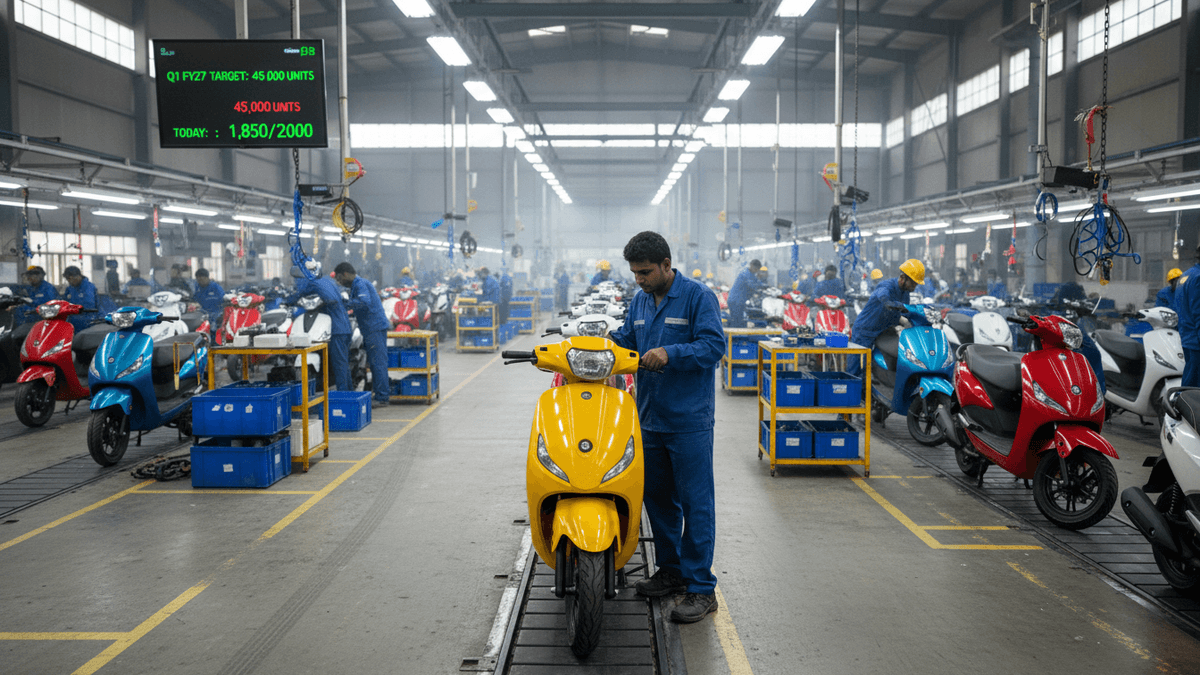
Worker inspects electric scooter on assembly line at Indian factory
Shares of Ola Electric experienced a significant surge, climbing over 9% during intraday trading on the BSE to reach a high of ₹42.84. This upward movement reflects a positive shift in investor sentiment, driven by improving operational performance and initial indications of demand revival in the electric scooter market.
The company’s market capitalization stood at approximately ₹18,525.4 crore (about $1.9 billion) at the time of the trading surge. The stock has shown resilience, rallying nearly 14% in the preceding two trading sessions and more than doubling from its 52-week low of ₹21.21 recorded on March 2, 2026. Despite this recovery, the stock remains below its 52-week high of ₹71.24, achieved on September 4, 2025.
The recent positive performance follows a mixed Q4 FY26 earnings report, which nonetheless highlighted better margins and reduced costs, alongside nascent signs of increased demand. Further bolstering investor confidence, Ola Electric reportedly secured ARAI approval for a new electric scooter designed for commercial applications, including delivery and logistics services.
Data from VAHAN indicates a promising start to Q1 FY27, with approximately 22,600 registrations, surpassing the 22,221 units registered in Q4 FY26. This suggests a rebound in demand following a subdued March quarter. Ola Electric has projected between 40,000 to 45,000 orders and revenues of ₹500-₹550 crore for Q1 FY27, signaling a strong sequential recovery if current momentum is sustained.
In Q4 FY26, Ola Electric reported a narrowed net loss of ₹500 crore, a 43% decrease year-on-year from ₹870 crore, though it saw a 3% sequential increase. Revenue declined by 57% year-on-year to ₹265 crore, attributed to lower delivery volumes. Deliveries dropped 61% year-on-year to 20,256 units, while total expenses were reduced by 57% to ₹546 crore, indicating improved cost management.
The company achieved its first positive operating cash flow quarter, reporting ₹91 crore, supported by Production Linked Incentive (PLI) benefits, enhanced margins, and stringent cost controls. For the full fiscal year FY26, the net loss decreased by 20% to ₹1,833 crore, while revenue saw a 50% decline to ₹2,460 crore. FY26 was characterized as a “reset year,” focusing on enhancing service quality, margins, and operational efficiency. Gross margins improved to 38.5% in Q4, and warranty costs saw a substantial reduction from ₹555 crore to ₹59 crore.
Ola Electric reported significant improvements in service performance, with turnaround times decreasing from 9 days to approximately 1 day, and same-day resolution rates increasing to 87%. The company aims to recapture a 15-20% market share within the next six months and expand its electric motorcycle business. The construction of its 6 GWh gigafactory is nearing completion, with production slated to commence in Q1 FY27, followed by an expansion to 20 GWh.
Despite auditors noting a negative operating cash flow of ₹775 crore in FY26, this marked an improvement from the prior year. The company maintains stable liquidity through cash reserves, credit lines, and a planned ₹1,500 crore Qualified Institutional Placement (QIP). While near-term margin pressures may persist due to rising costs, Ola Electric anticipates a volume recovery and a gradual progression towards profitability in FY27.
About the Author