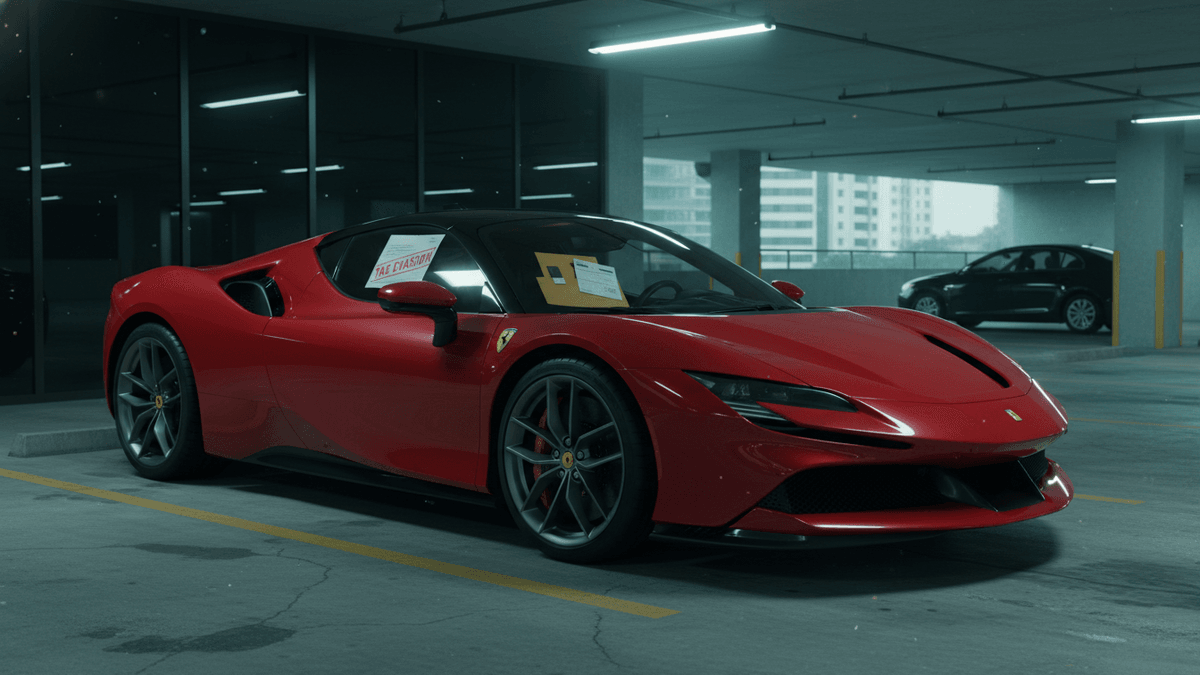
Red supercar with a "TAX EVASION" notice in an underground parking garage.
Kwanghyun Lim, a prominent figure in financial commentary, has issued a strong warning against the practice of purchasing supercars under corporate names for personal use, labeling it as outright tax evasion.
The statement, reported by Asia Economy, underscores a critical issue in corporate financial management and tax compliance. Lim emphasized that such actions are not merely aggressive tax avoidance but clear-cut evasion, indicating a deliberate intent to mislead tax authorities.
This practice often involves establishing a corporate entity or utilizing an existing one to acquire high-value assets like supercars. These vehicles are then used for personal enjoyment by company executives or owners, while the associated costs, including purchase, maintenance, and insurance, are deducted as business expenses. This artificially reduces the company’s taxable income, leading to lower tax liabilities.
Lim’s assertion points to the potential for significant legal and financial repercussions for individuals and companies engaging in such schemes. Tax authorities globally are increasingly scrutinizing corporate expenses, particularly those that appear to blur the lines between legitimate business operations and personal benefits.
The core of the issue lies in the misrepresentation of personal expenditure as a business cost. While companies can legitimately own assets for business purposes, using them primarily for personal luxury without proper declaration and taxation is a violation of tax laws. This practice not only defrauds the government of rightful tax revenue but also distorts fair competition by providing an unfair advantage to those who engage in it.
As financial oversight tightens, experts like Kwanghyun Lim urge businesses to maintain strict adherence to financial regulations, ensuring that all expenditures are justifiable and accurately reported to avoid severe penalties, including hefty fines and potential criminal charges.
About the Author