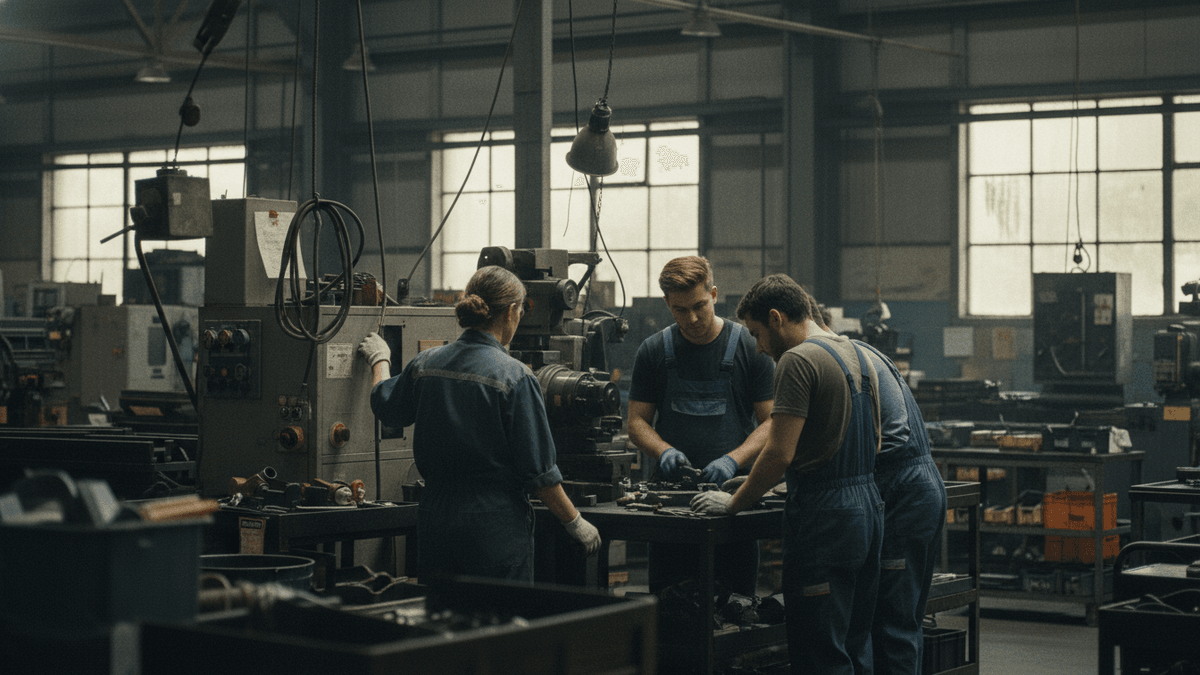
Factory workers collaborate on the shop floor amidst evolving industrial landscapes.
The narrative surrounding an impending “AI jobpocalypse” is increasingly being viewed as a convenient smokescreen for broader economic adjustments within the tech sector. Experts and industry leaders are suggesting that many companies are leveraging the discourse around artificial intelligence to mask post-pandemic corrections, cost-cutting measures, and strategic restructurings.
Andrew Ng, AI researcher and cofounder of Coursera, noted that businesses have a strong incentive to attribute layoffs to AI, framing it as a sign of smart, forward-thinking operations. This narrative is seen as more favorable than admitting to the overhiring that occurred during the pandemic when capital was abundant due to low interest rates and significant government stimulus. The global tech industry has been undergoing a reset following this period of aggressive hiring, with slowing growth and increased capital costs forcing organizations to re-evaluate inflated workforce structures.
Pankaj Goel, CTO of AI-powered CRM platform LeadSquared, echoed this sentiment, stating that AI has become an “easy headline” for changes already in motion. He believes the current trend is less about AI replacing jobs and more about companies redistributing work towards higher-order problem-solving and decision-making. “In engineering, a single developer with the right AI tools can now ship what used to take a small team. If anything, this is just a productivity story more than a replacement story,” Goel added.
While AI is undeniably transforming workflows and accelerating specific tasks, its impact on job displacement is still far from visible for many enterprises. Many organizations are reportedly struggling with basic AI adoption and workforce integration, highlighting a gap between the promised AI-driven transformation and its actual implementation. Khadim Batti, cofounder and CEO of Whatfix, an Indian SaaS-based digital adoption platform, pointed out that numerous organizations are still grappling with getting employees to use existing AI tools effectively.
Experts suggest that AI has become the perfect corporate narrative for difficult business decisions. Companies like Oracle, Coinbase, and Freshworks have cited AI-led productivity improvements or shifts toward AI as reasons for workforce reductions, while simultaneously reallocating capital toward AI infrastructure, cloud expansion, and strategic investments. This framing allows companies to manage operational tightening and protect margins under the guise of technological advancement.
Beerud Sheth, cofounder and CEO of Gupshup, a conversational AI platform, acknowledged that AI will inevitably create some redundancies but emphasized that focusing solely on layoffs overlooks the larger shift. “For companies with vision, AI-driven superproductivity unlocks entirely new markets and product lines. AI is fundamentally a growth engine, not a cost lever, unless you choose to use it that way,” Sheth stated.
The more profound long-term impact of AI is expected to be in how companies hire, structure teams, and define work. Engineering teams, for instance, are seeing significant changes, with smaller, AI-assisted pods taking on tasks previously handled by larger groups. The focus is shifting from doing the same with less to building what was previously impossible. The nature of engineering itself is evolving, with product managers becoming builders, designers prototyping code, and engineers operating across broader execution layers. This fall in the cost of building software is expected to drive increased development rather than reduced employment.
Ultimately, AI is anticipated to redefine job roles and required skills rather than eliminate work wholesale. The trend indicates a move away from repetitive tasks towards roles that involve collaboration with AI, demanding adaptability and new skill sets from the workforce.
About the Author