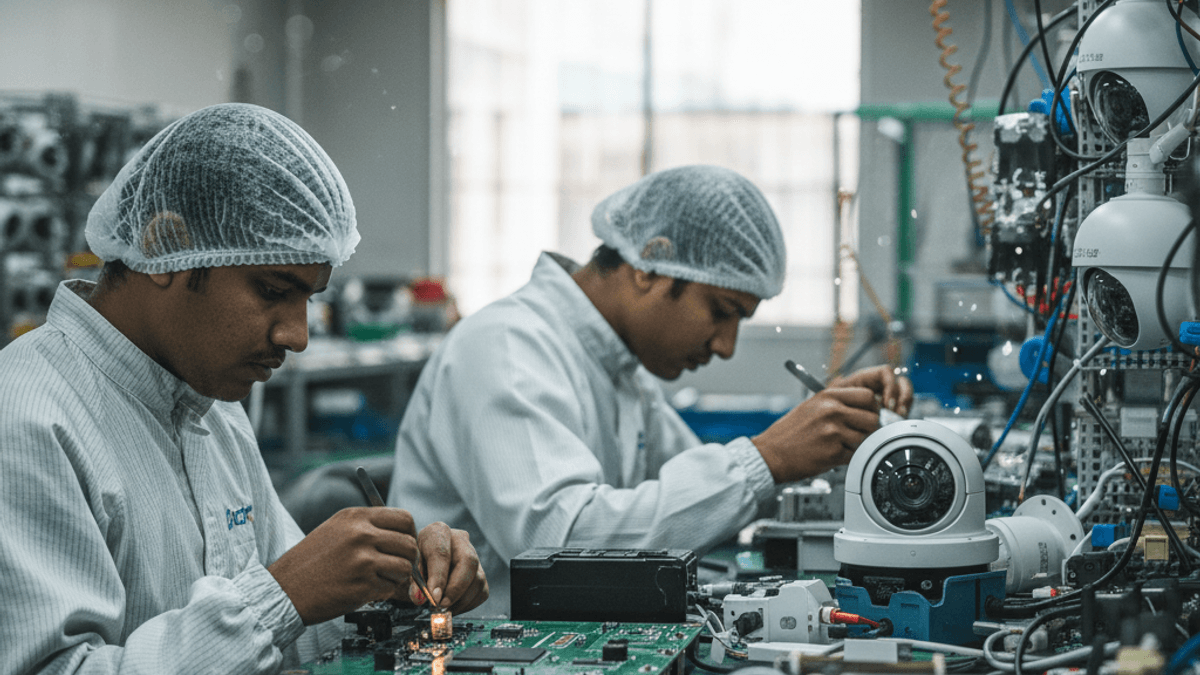
Indian technicians assemble circuit boards for CCTV cameras in a manufacturing facility.
India’s recent imposition of restrictions on uncertified internet-connected CCTV cameras, effective April 1, 2026, has created a significant market vacuum, particularly impacting dominant Chinese brands like Hikvision and Dahua. This regulatory shift, driven by mandatory STQC certification norms, is spurring a “gold rush” for domestic Indian startups and Original Equipment Manufacturers (OEMs) in the surveillance technology sector.
The Indian CCTV market, valued at $4.8 billion in 2025 and projected to reach $14.25 billion by 2031, is witnessing a substantial influx of investment and strategic realignment. Companies like CP PLUS, through its parent Aditya Infotech, have seen their market share surge from 20.2% in FY25 to 45.4% by Q3 FY26, driven by increased demand for compliant and secure surveillance solutions, especially from government and enterprise clients prioritizing cybersecurity and data sovereignty.
Beyond established players, the policy change is creating fertile ground for semiconductor startups and AI surveillance firms. Bengaluru-based BigEndian Semiconductors, developing Vision AI chips for surveillance and edge AI applications, recently secured $6 million in pre-Series A funding. The company aims to capitalize on the demand for trusted domestic alternatives, estimating the chip opportunity in India’s surveillance segment to reach nearly $1 billion.
Similarly, Chennai-based Mindgrove Technologies is developing a specialized CCTV system-on-chip (SoC) called Vision SoC, with market entry anticipated by early-to-mid 2027. L&T Semiconductor Technologies is also developing India-designed SoCs for AI-powered CCTV systems, collaborating with CP PLUS on indigenous IP SoCs for high-resolution surveillance cameras.
The AI video analytics sector is also benefiting, with startups like Staqu Technologies repositioning surveillance systems as intelligent digital infrastructure. The focus is shifting from camera count and cost to trusted infrastructure, local deployment, data residency, and AI capabilities, offering actionable intelligence rather than just footage recording.
While challenges remain, including dependence on imported components and the long-term goal of achieving cost parity with Chinese manufacturers, the current regulatory environment presents a unique window of opportunity. This is attracting significant venture capital and private equity interest, signaling a strategic shift towards developing a robust and indigenous surveillance technology ecosystem in India.
About the Author