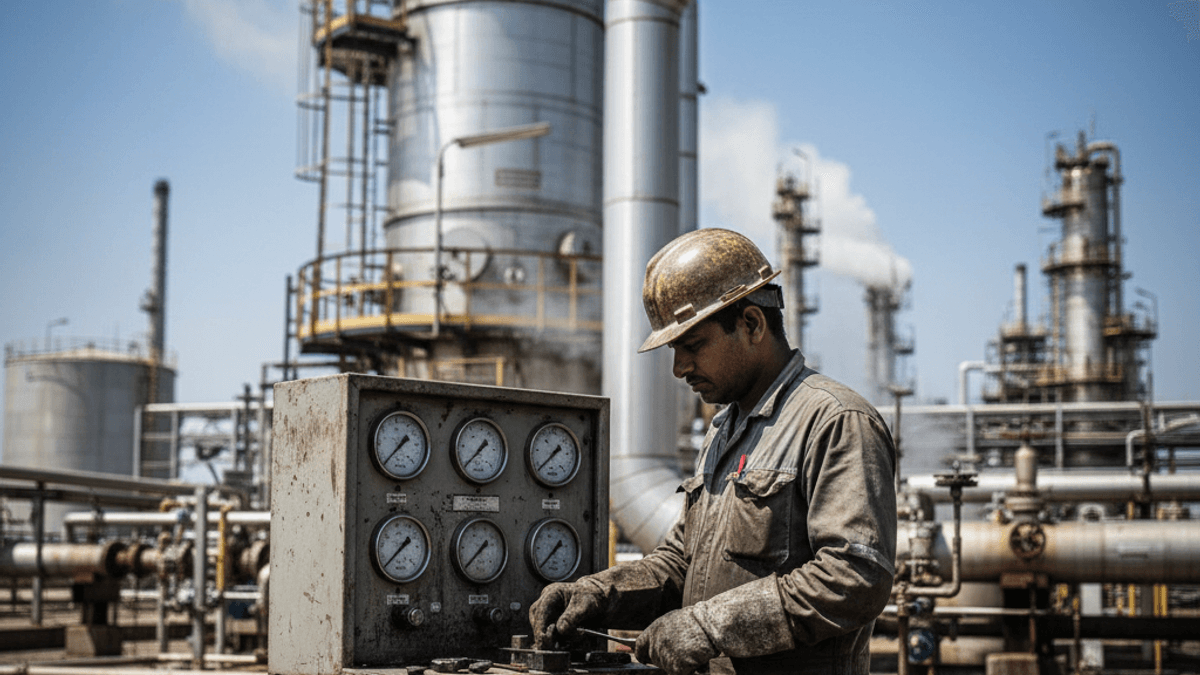
A worker in a refinery amidst industrial equipment, symbolizing India's energy stability.
India’s economy is demonstrating notable resilience in the face of the ongoing West Asia crisis, successfully insulating consumers from a sharp global rise in crude oil prices. This stability in domestic fuel pricing is attributed to a confluence of factors, including robust internal demand, significant expansion in the country’s refining capacity, and a growing contribution from renewable energy sources.
The nation’s ability to absorb external shocks in the energy market has been a key achievement. While international crude oil prices have experienced significant fluctuations due to geopolitical tensions in West Asia, India has managed to keep its retail fuel prices relatively steady. This has been a critical factor in maintaining economic equilibrium and consumer confidence.
Government intervention has also played a crucial role in this strategy, with policies aimed at safeguarding the domestic market from extreme volatility. The expanding refining capacity ensures that India can process crude oil efficiently, meeting domestic demand without over-reliance on imports of refined products. Furthermore, the increasing share of renewable energy in the country’s energy mix contributes to diversifying supply and reducing dependence on fossil fuels, thereby enhancing overall energy security.
This sustained fuel resilience is a testament to India’s strategic approach to energy management, balancing economic growth with energy security and consumer affordability in a turbulent global environment.
About the Author