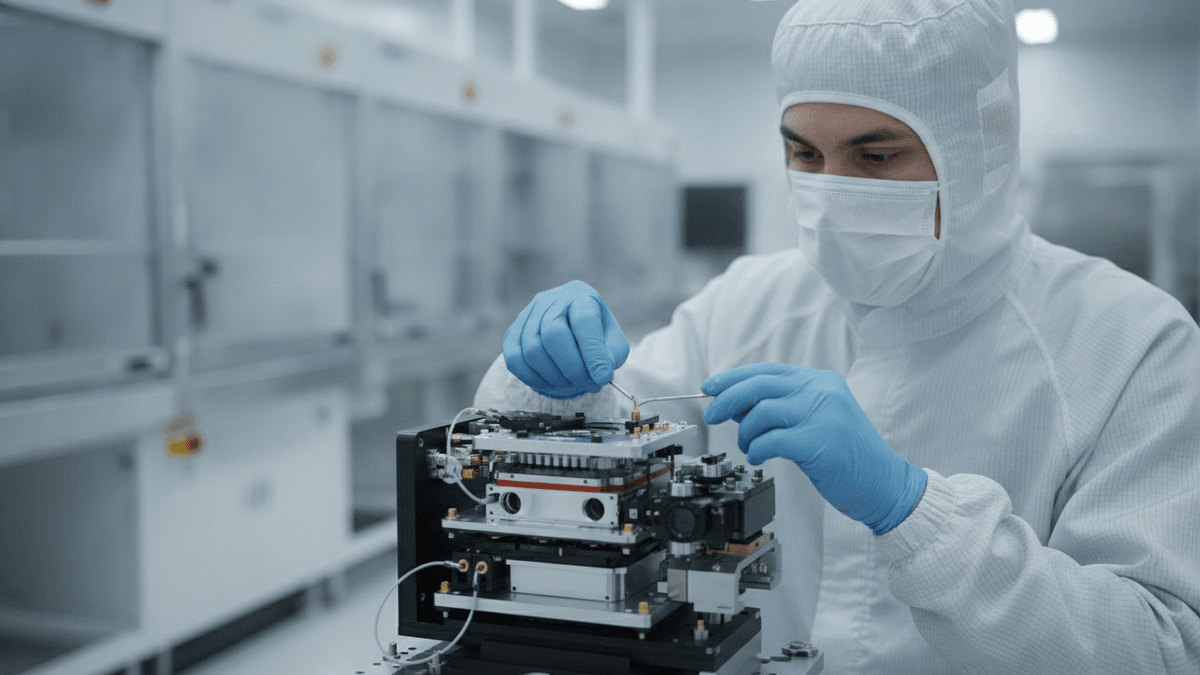
Technician assembling a precision component for a photolithography system.
India is strategically positioning itself within the global semiconductor ecosystem, signaling a significant shift in its approach to the industry. This move contrasts with China’s parallel pursuit of technological self-sufficiency, particularly in the critical area of lithography machines.
Tata Electronics is reportedly in discussions with ASML, the world’s leading supplier of photolithography equipment, to manufacture components and subassemblies for advanced lithography systems in India. This potential collaboration aims to elevate India’s capabilities in precision manufacturing and engineering, allowing it to move upstream in the complex semiconductor supply chain. By adhering to ASML’s stringent quality standards, India seeks to build advanced manufacturing infrastructure and integrate into a sector vital for global technological advancement.
Meanwhile, China has been investing heavily in developing its own immersion deep ultraviolet (DUV) lithography machines, a technology segment where ASML currently holds a dominant global position. This domestic push by China is partly driven by increasing US-led export controls, which aim to curb its access to advanced semiconductor technology. While China’s indigenous efforts are still nascent and far from challenging ASML’s commercial offerings, they represent a determined bid for technological autonomy in a strategically crucial industry.
The developing semiconductor landscape presents distinct opportunities for ASML. As China potentially reduces its reliance on imported lithography systems, India emerges as a significant, growing market. India’s ambitious semiconductor mission, backed by substantial government investment in fabrication plants and a drive for supply chain localization, positions it as a key future consumer of advanced semiconductor manufacturing equipment.
Ultimately, India’s involvement in the equipment supply chain, even at the subassembly level, is a critical step. It allows the nation to cultivate essential precision manufacturing and engineering expertise. This capacity-building is not only vital for the semiconductor industry but can also have ripple effects across other high-tech sectors, establishing India as a more comprehensive contributor to the global technology landscape.
About the Author