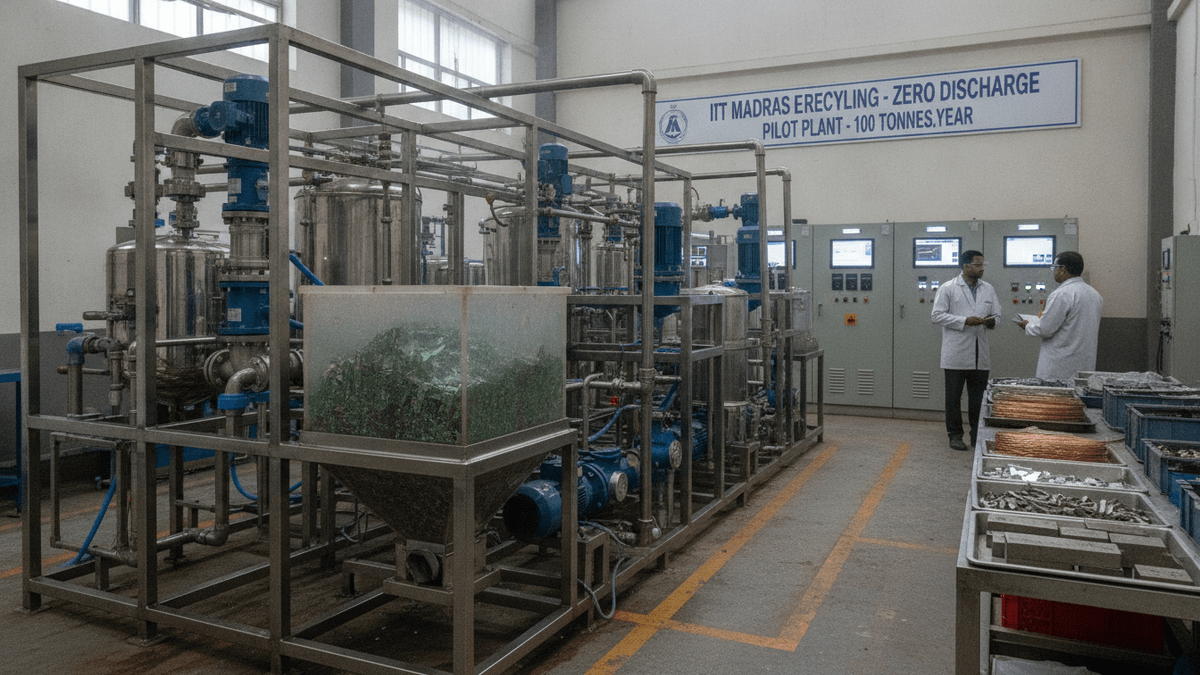
IIT Madras e-waste pilot plant interior, two researchers discussing data.
Researchers at the Indian Institute of Technology Madras (IIT Madras) have developed and established a novel pilot plant in Tiruchirapalli, designed to process 100 tonnes of electronic waste per year. This significant development aims to enhance India’s capacity for sustainable e-waste management and valuable resource recovery.
The facility specifically targets bare printed circuit boards (PCBs), a common component in electronic devices, for the recovery of high-value metals such as copper, lead, and tin. The innovative process employed utilizes a single acid, a method that ensures a zero-discharge outcome, thereby minimizing environmental impact and promoting a closed-loop system.
This initiative by IIT Madras aligns with the national ‘Make in India’ campaign and reinforces the principles of a circular economy. By enabling domestic processing of e-waste and recovering critical materials, the pilot plant contributes to reducing reliance on imports and fosters a more sustainable industrial ecosystem. The development is particularly noteworthy for its focus on indigenous technology, supporting India’s self-sufficiency in critical resource management.
About the Author