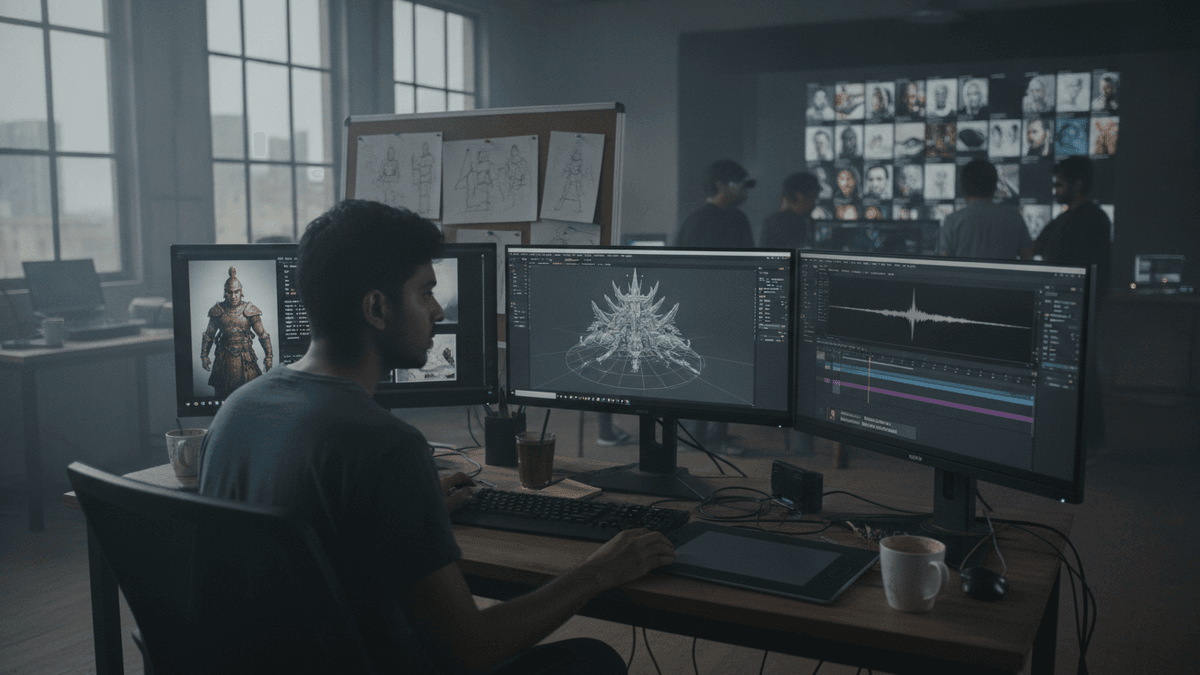
Filmmaker working with generative AI tools for concept art and audio editing
Generative artificial intelligence (AI) is rapidly reshaping the film industry, challenging traditional production models and lowering the barriers to entry for content creation. Historically, filmmaking has been capital-intensive, requiring significant investment in equipment, large crews, and extensive post-production timelines. However, the advent of sophisticated AI tools is democratizing the process, allowing for more ambitious projects at a fraction of the previous cost.
Notable examples of AI’s impact include JioStar’s AI adaptation of the Mahabharat, which garnered millions of views, and Studio Blo’s collaboration with filmmaker Rajkumar Hirani on an AI-native branded film for the Bajaj Group, utilizing AI for facial cloning, voice recreation, and visual storytelling. These developments signal a broader industry shift, with AI-native studios emerging and filmmakers integrating generative tools across the production lifecycle.
AI is proving instrumental in various stages of filmmaking. In pre-production, AI assists with storyboarding and rapid concept generation for characters, environments, and visual styles, significantly compressing iteration cycles that once required extensive manual design work. For instance, Astra Studios leverages AI to quickly generate numerous concept variations for film assets.
In visual effects (VFX), AI is being employed for tasks such as image-to-3D generation for secondary characters and environmental assets. Major software ecosystems like Adobe, Houdini, and Foundry are integrating AI-assisted tooling to accelerate repetitive VFX tasks. Startups like NeuralGarage are developing solutions for dialogue correction and facial expression editing, further streamlining post-production.
The economic implications of AI in filmmaking are profound. AI-assisted pipelines can drastically reduce the cost of producing large-scale projects, such as mythological epics, which previously demanded hundreds of crores. This reduction in cost and risk-taking allows independent creators, regional storytellers, and smaller studios to pursue projects that were once financially prohibitive.
Despite these advancements, human expertise remains critical. Current AI filmmaking often involves hybrid pipelines where traditional filmmaking roles—cinematographers, VFX artists, editors—collaborate with AI systems. Maintaining character consistency, lighting, and narrative coherence still requires significant human oversight. The industry is evolving towards AI-assisted production environments where human creativity drives intent and storytelling, while AI enhances scale and flexibility.
As AI continues to integrate into filmmaking workflows, it is becoming a creative collaborator rather than a replacement for human filmmakers. While traditional shoots are still prevalent, AI augmentation is increasingly layered across pre-production, VFX, and editing. The emergence of AI-native studios and the development of proprietary IP engines suggest a future where AI and human creativity work in tandem, ensuring that human ingenuity remains indispensable.
About the Author