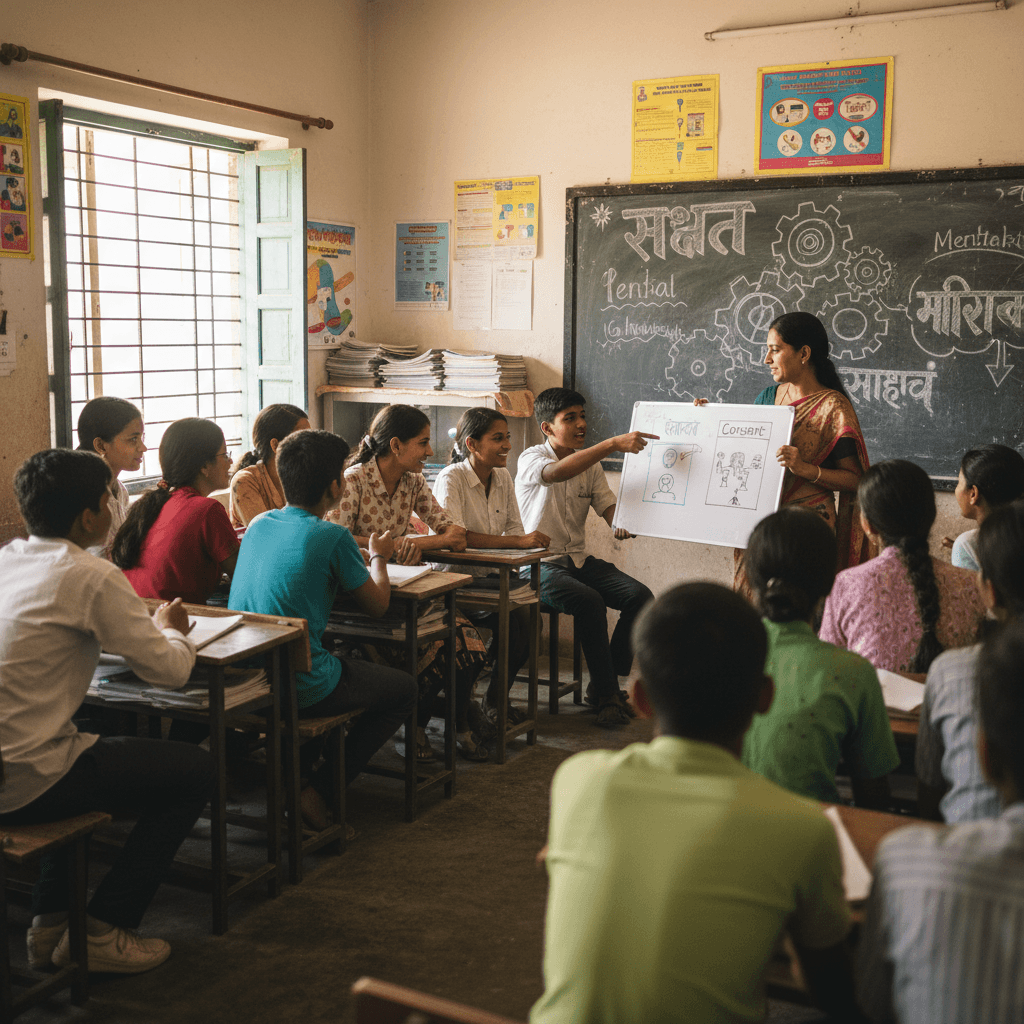
An Indian teacher leads a life-skills class on consent with adolescent boys and girls.
India, while having established numerous policies aimed at achieving gender equality, is witnessing a shift in approach to address the disparity between stated goals and on-the-ground realities. Instead of treating gender as an isolated concern, there’s a growing movement to embed it within everyday systems, influencing education, governance, and institutional responses to violence.
Actor and UNFPA India Honorary Ambassador Kriti Sanon’s recent field visit brought attention to some of these initiatives. In schools, life-skills programs are introducing adolescents to topics such as mental health, relationships, and consent. Some programs are actively involving boys in these conversations, challenging the notion that gender equality is exclusively a ‘women’s issue.’
At the local governance level, women’s representation is moving beyond mere quotas. In certain areas, their presence is beginning to shape fundamental priorities like safety, sanitation, and access to public resources. These changes, though modest, are tangible, partly due to the support of organizations like the UN Population Fund.
The role of the police is also undergoing transformation, with efforts underway to make responses to gender-based violence more accessible and less intimidating. Building trust is a lengthy process, but recognizing the need for a more community-driven approach is a vital first step.
This shift, though complex with deeply ingrained social norms and inconsistent implementation, signifies a quieter, less conspicuous evolution. Gender equality is tentatively beginning to manifest in daily interactions and decisions, marking a pathway through which genuine change ultimately unfolds.
About the Author