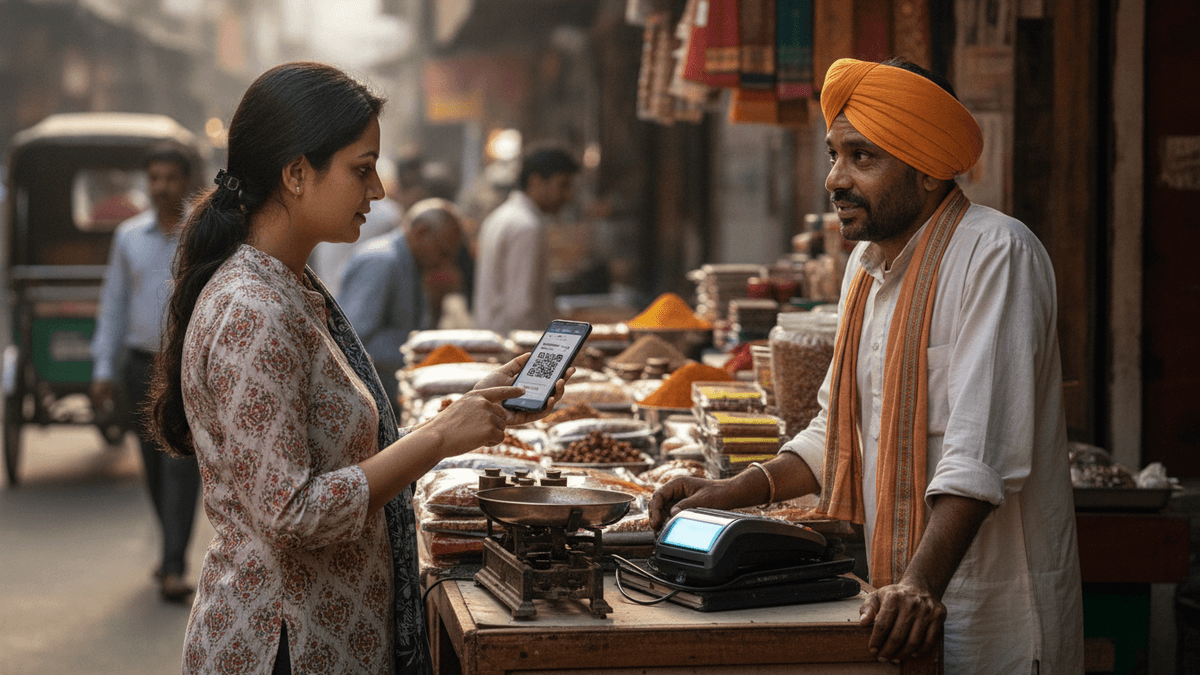
Customer makes digital payment to merchant at an Indian market stall.
India’s Unified Payments Interface (UPI), a system that has revolutionized digital transactions over the past decade, is on the cusp of a significant shift. The Indian government has opened the possibility of introducing a Merchant Discount Rate (MDR) on certain UPI transactions, a move that could fundamentally alter the ‘free’ digital payment ecosystem that has driven its widespread adoption.
The Lok Sabha recently passed the Taxation and Other Laws (Amendment) Bill, 2026, which amends the Payment and Settlement Systems Act, 2007, creating a legal pathway for MDR charges. While Finance Minister Nirmala Sitharaman has clarified that any such charges would be levied on merchants and not consumers, the potential introduction of MDR raises questions about the sustainability of UPI’s zero-fee model.
The rationale behind considering MDR, according to proponents like the Reserve Bank of India (RBI) governor, is to enable banks and fintech companies to invest further in the infrastructure, innovation, and security of the UPI network. The Payments Council of India (PCI) has also supported the move, emphasizing the need for sustained investment to ensure the reliable operation of the real-time payments system.
For nearly a decade, UPI has operated on a zero-MDR principle, allowing for fast, frictionless, and free digital payments. This model has been instrumental in making UPI an intrinsic part of daily financial life for millions of Indians. However, as transaction volumes have surged—processing billions of transactions monthly—the cost of maintaining this extensive ecosystem has become a growing concern.
Industry estimates suggest that substantial annual funding is required to cover the costs associated with person-to-merchant (P2M) transactions. The government’s incentive schemes, while supportive, have not kept pace with the network’s exponential growth, leading to a situation where the model is increasingly difficult to sustain.
The debate around MDR is further complicated by potential international influences. Reports suggest that the US government, through its trade representative, has previously flagged India’s zero-MDR policy for UPI and RuPay as a potential barrier that could disadvantage foreign payment networks like Visa and Mastercard, which operate on a fee-based model.
The proposed MDR framework is reportedly designed to target larger merchants with annual turnovers of ₹1-1.5 crore or more, with a potential fee of 0.05%-0.07% on UPI transactions exceeding ₹2,000. This approach aims to exempt smaller merchants and low-value transactions, thereby monetizing a specific segment of UPI usage.
While a 0.05%-0.07% MDR might seem negligible compared to the historical MDR on card payments (around 1.8%), consumer perception could be a significant factor. Surveys indicate that a considerable portion of users might alter their payment behavior for higher-value transactions if MDRs are imposed, potentially shifting to other methods like credit cards, debit cards, or bank transfers.
The introduction of MDR could benefit enterprise-focused payment aggregators and banks by providing a revenue stream to recover infrastructure investments. However, consumer-facing apps like PhonePe, Google Pay, and Paytm might not be the primary beneficiaries, as their revenue models are often diversified. The ultimate success of the MDR implementation will depend on the government’s ability to balance the need for sustainable funding with the preservation of user habits that have made UPI a resounding success.
About the Author