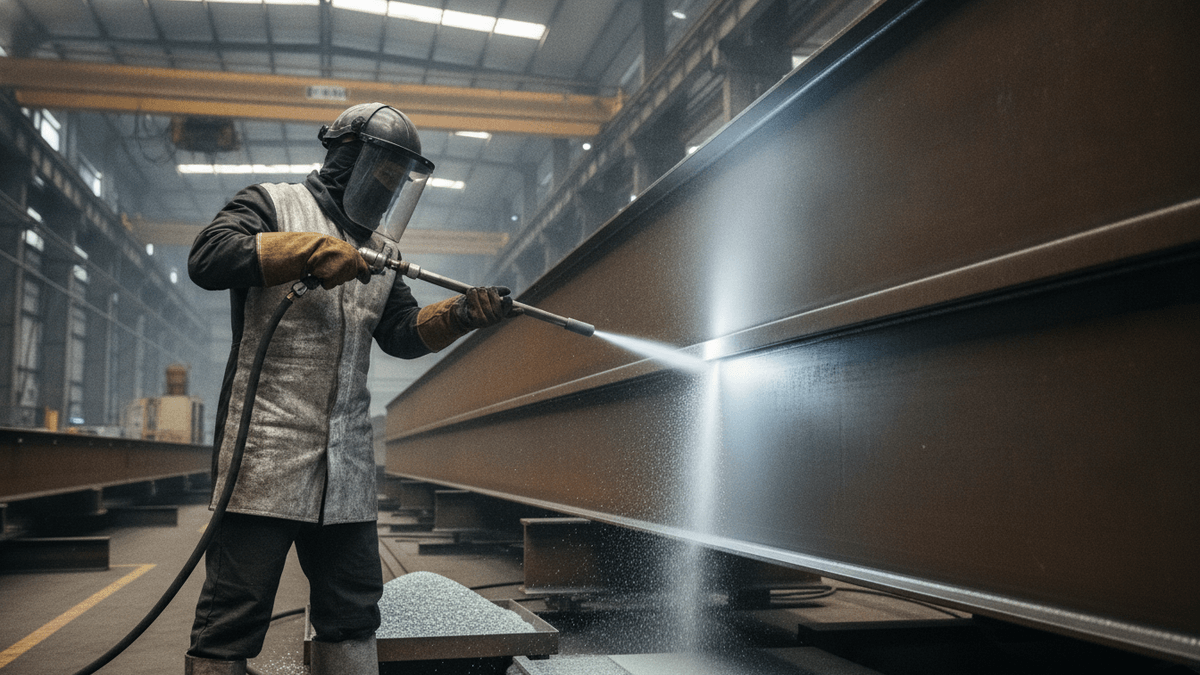
Worker blasting a steel beam with glass abrasive in a fabrication plant
The global glass abrasives market is charting a course for significant expansion, projected to reach USD 369.99 million by 2035, up from USD 265.87 million in 2025. This growth trajectory, estimated at a Compound Annual Growth Rate (CAGR) of 3.36% from 2026 to 2035, is largely propelled by an increasing industrial demand for abrasive materials that are both recyclable and silica-free. According to recent market insights, a substantial majority of industrial users are now prioritizing environmentally friendly blasting media, with a corresponding emphasis on recyclable products to enhance workplace safety and reduce dust generation.
The market segmentation reveals that medium-sized abrasives currently hold the largest market share, accounting for 40% in 2025. Key application sectors driving this demand include the steel industry, which represented 37% of the market in the same year, followed by the construction and automotive industries. Geographically, North America leads the market with a 32% share, closely followed by Asia-Pacific at 30% and Europe at 28%. The Middle East & Africa region comprises the remaining 10%.
The expansion is further bolstered by the ongoing restoration and maintenance of infrastructure projects worldwide and a heightened focus on low-dust and silica-free abrasive technologies. However, the market faces challenges from competition from alternative blasting materials and the need for consistent product quality and supply chain reliability. Key industry players, including Strategic Materials, Luanxian Sanlian Glass Beads Co. Ltd., SICHENG ABRASIVES, and Zhengzhou Haixu Abrasives Co. Ltd., are actively engaged in improving dust control, expanding production capacities, and enhancing processing efficiency.
The future outlook for the glass abrasives market remains robust, underpinned by a persistent shift towards sustainable and recyclable solutions, technological advancements, and increasingly stringent environmental regulations influencing industrial practices.
About the Author