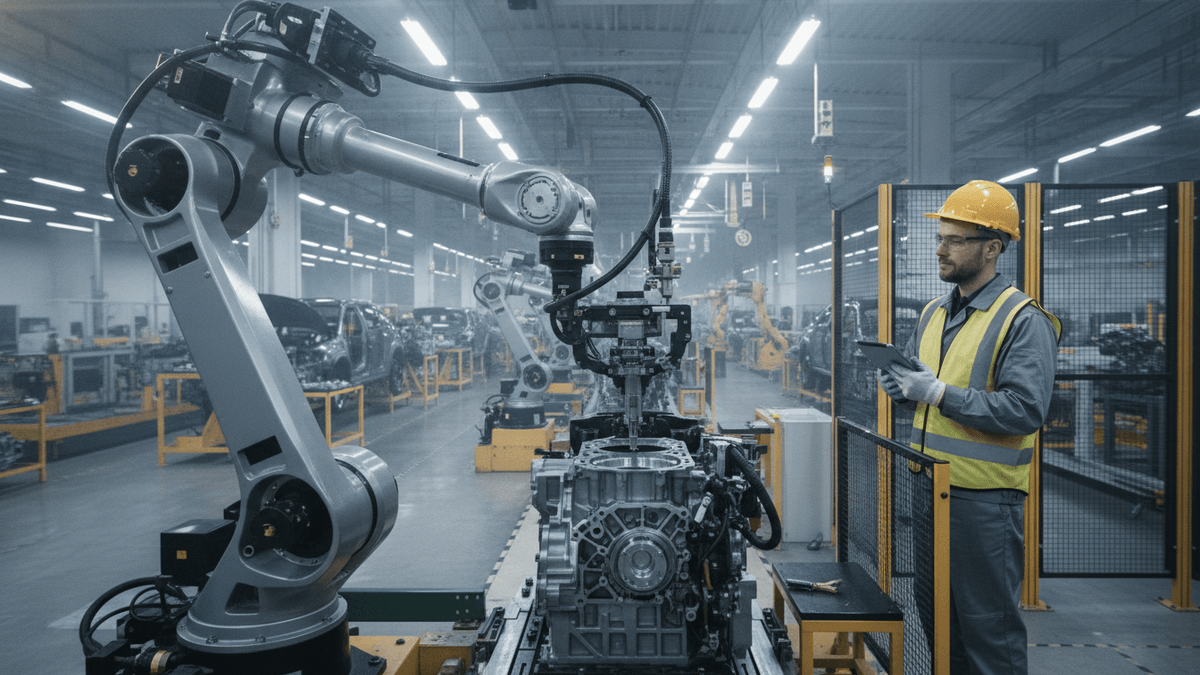
Robotic arm and human operator collaborate on a manufacturing production line.
Artificial Intelligence (AI) is rapidly becoming integral to the industrial machinery sector, driving significant advancements in efficiency, quality, and operational resilience. Technologies such as machine learning, computer vision, and natural language processing are now moving beyond pilot phases to become standard tools for manufacturers navigating challenges like labor shortages, supply chain volatility, and unplanned downtime.
The integration of AI addresses critical operational areas. In OT/IT Cybersecurity, AI enhances threat detection and incident response. Predictive Maintenance leverages AI to analyze equipment data, predicting failures and optimizing maintenance schedules, thereby reducing costly downtime. Workforce Augmentation uses AI-guided robotics to assist human operators, improving productivity and safety, particularly in tasks like assembly and machine tending.
Furthermore, AI-driven Quality Inspection employs computer vision for high-accuracy defect detection. Supply Chain Optimization benefits from AI-powered demand forecasting and inventory management, while Production Throughput is enhanced through AI-driven process optimization and scheduling. AI is also accelerating Product Design and Engineering through generative design and simulation tools. In procurement and administration, AI improves efficiency in Procurement and Supplier Risk Management and automates Administrative Tasks. Finally, AI enhances Pricing Accuracy and Sales Processes through intelligent CPQ (Configure, Price, Quote) systems.
Despite these benefits, the implementation of AI faces several challenges. These include workforce adoption, data quality issues, talent gaps, integration complexities with legacy systems, significant capital expenditure, and the need to manage alert fatigue. The article highlights that a unified data platform is crucial for successful AI deployment. Oracle NetSuite ERP is presented as a foundational solution, capable of integrating disparate data sources from inventory, production, financials, and customer records, thereby enabling the effective use of AI and providing real-time visibility into key operational metrics for manufacturers.
About the Author