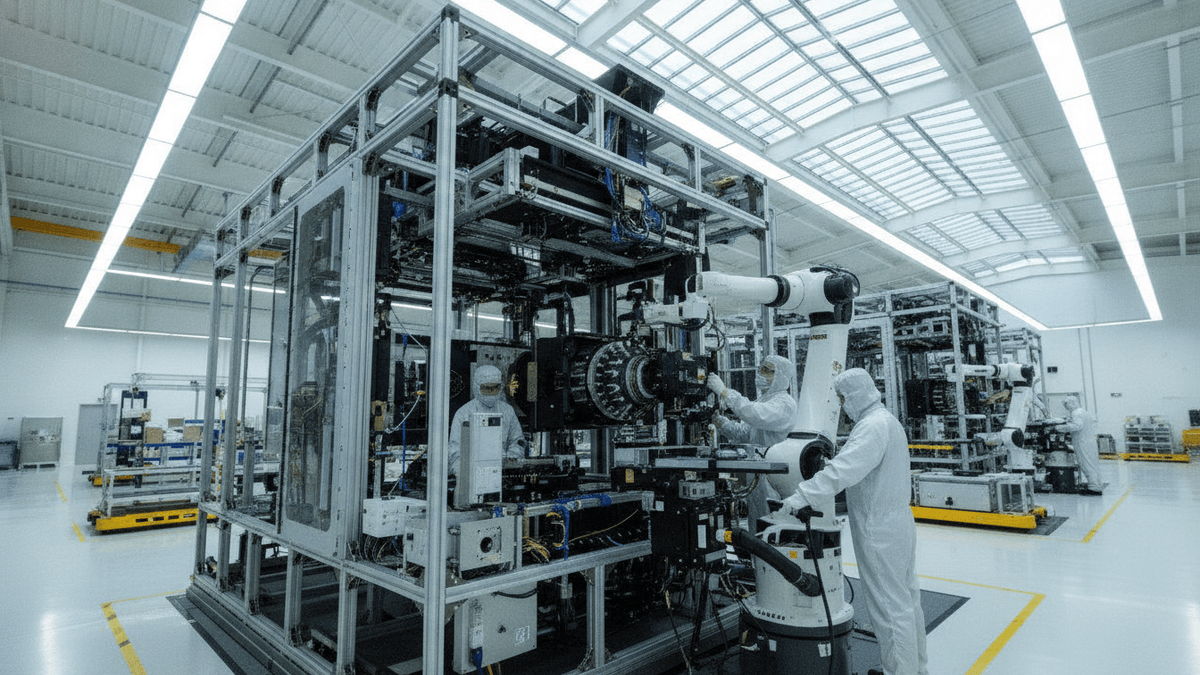
Technicians assemble industrial machinery in a modern manufacturing facility.
The United States machinery market is witnessing a robust investment cycle, with new orders accelerating beyond shipment capabilities. This trend, a historical indicator of heightened machinery production and capital expenditure, saw inflation-adjusted orders climb significantly between January 2025 and March 2026. This surge has created an order-shipment gap of approximately $3.9 billion, signaling strong future demand.
The primary driver for this growth is the semiconductor machinery sector, bolstered by investments stemming from the CHIPS Act and ongoing expansion related to artificial intelligence. The construction machinery segment is also contributing to this upward trend, while material handling equipment, after a period of weakness, shows signs of stabilization.
This growing backlog provides manufacturers with greater visibility into future demand, which is expected to translate into increased factory utilization, hiring, and capital investment. Consequently, machinery output is poised for an expansion.
The next phase of production growth is anticipated to concentrate in key industrial states. Texas is benefiting from a confluence of energy, infrastructure, and semiconductor projects. Michigan is experiencing a resurgence driven by automotive investments, automation adoption, and reshoring initiatives. Ohio’s industrial landscape is being shaped by Intel’s significant fab expansion, and Wisconsin continues its role as a vital hub for material handling equipment manufacturing.
To navigate these emerging opportunities, Interact Analysis has introduced a state-level forecasting platform. This tool aims to assist businesses in identifying precise areas of demand, understanding growth drivers within specific industries, and pinpointing states that offer the most significant potential for strategic sales planning, distributor network development, and investment decisions.
About the Author