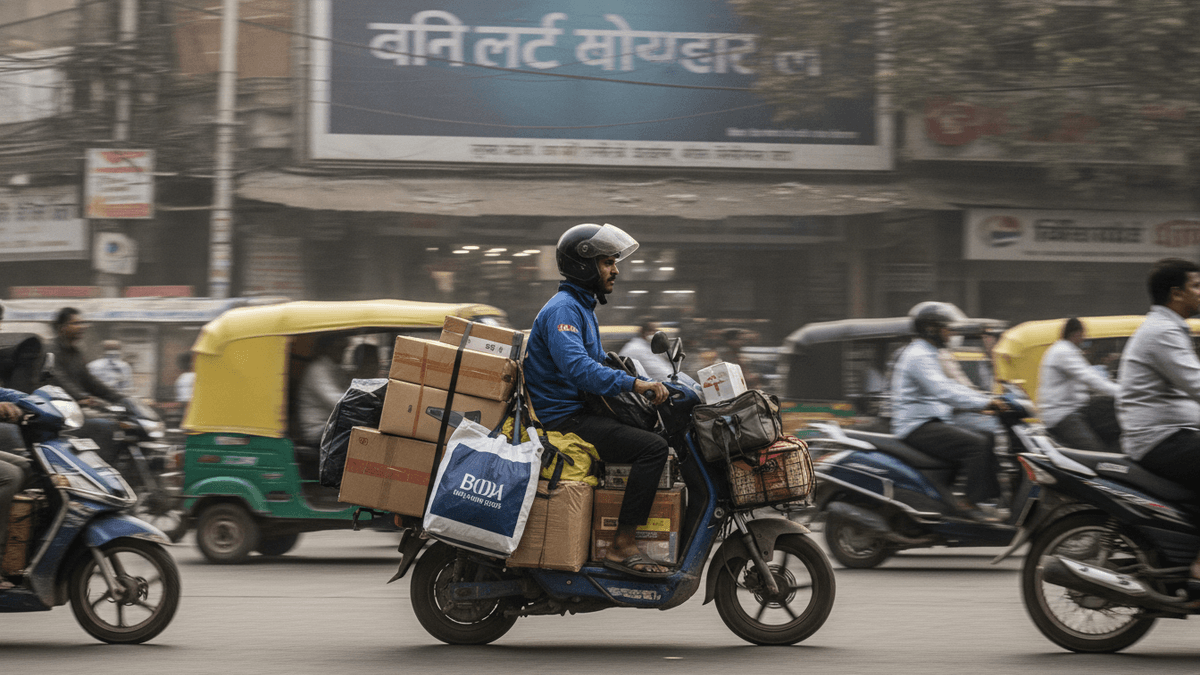
Delivery rider on a scooter in an Indian city
Reliance Retail Ventures Ltd. (RRVL) experienced an erosion in its EBITDA margin, falling 80 basis points to 7.9% in the first quarter of fiscal year 2027, compared to 8.7% in the same quarter last year. This sequential decline is attributed to the company’s strategic expansion in quick commerce, which has led to increased fixed costs associated with infrastructure investments.
While rivals like Blinkit, Instamart, and Zepto focus on 10-minute deliveries, JioMart’s quick commerce strategy targets hyperlocal orders within 30 minutes. This build-out of delivery infrastructure is expected to impact margins in the near term, though RRVL anticipates it will generate significant scale and value creation opportunities in the coming years.
Consequently, RRVL’s net profit saw a 14.2% decrease to ₹2,806 crore in Q1 FY27, despite a 8.2% rise in revenue from operations to ₹79,745 crore. The company highlighted the strong performance of its apparel delivery service, Ajio Rush, which recorded a 136% quarter-on-quarter order growth. JioMart also continued to scale its two-hour delivery service for apparel and electronics to over 5,500 pincodes nationwide.
In the digital commerce segment, JioMart has been focusing on enhancing customer experience through repeat purchases, order density, availability, and delivery cost efficiency. Digital commerce now contributes 27.3% to Reliance Retail’s apparel and footwear revenues, an increase of 490 basis points year-on-year.
Separately, Reliance’s digital arm, Jio Platforms, reported a 9.2% year-on-year increase in consolidated net profit to ₹7,764 crore in Q1 FY27. Overall, Reliance Industries Limited (RIL) posted a 5.7% year-on-year rise in net profit to ₹23,001 crore, with gross revenue growing 24.5% year-on-year to ₹3.40 Lakh crore.
About the Author