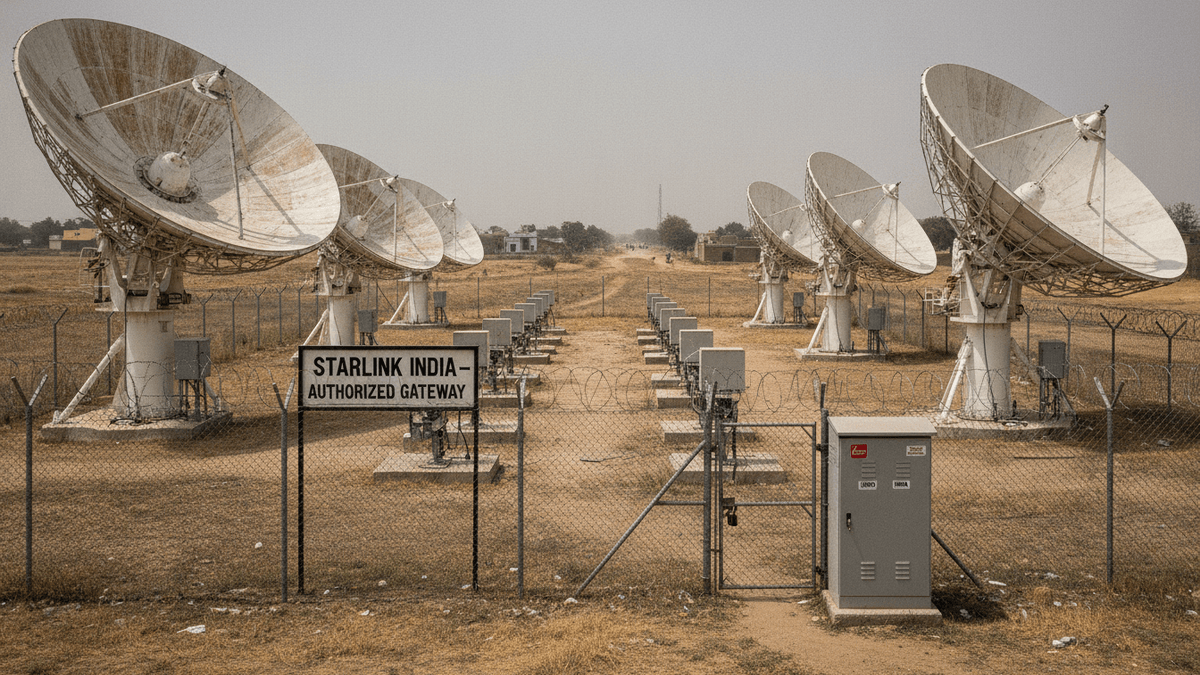
Starlink satellite gateway infrastructure in rural India under hazy midday light.
Starlink, the satellite internet constellation operated by Elon Musk’s SpaceX, has encountered a significant regulatory hurdle in its pursuit of launching services in India. The Indian government is reportedly hesitant to permit the use of Starlink’s interlinked satellites for internet services unless robust safeguards are implemented to address national security concerns, particularly regarding the routing of satellite data.
The core of the government’s concern lies in Starlink’s laser inter-satellite link (LISL) technology. This advanced system allows Starlink satellites to transmit data directly to one another in space, creating a mesh network that can route internet traffic without immediate reliance on ground stations. While this technology enhances global connectivity, it raises alarms for Indian authorities who fear that data generated by Indian users could be routed through servers located in foreign jurisdictions, potentially bypassing national borders and posing security risks.
Although Starlink has secured a basic satellite communication (satcom) license, it is still awaiting final security clearance from the Indian government. This latest development follows reports that the Ministry of Home Affairs (MHA) had previously put approvals on hold due to concerns over the use of Starlink’s satellite terminals in Iran amidst geopolitical tensions. Starlink has refuted these reports, emphasizing its ongoing, productive discussions with the Indian government and asserting adherence to all compliance requirements.
Authorities are exploring potential safeguards, which may include requiring Starlink to restrict or disable its inter-satellite routing capabilities for Indian traffic. There is also wariness regarding SpaceX’s ability to remotely manage the Starlink network, including routing configurations and coverage areas, capabilities that have reportedly been utilized during conflicts in Ukraine and West Asia. A potential compliance requirement could mandate that all traffic from Indian users be routed through gateways located within India.
About the Author