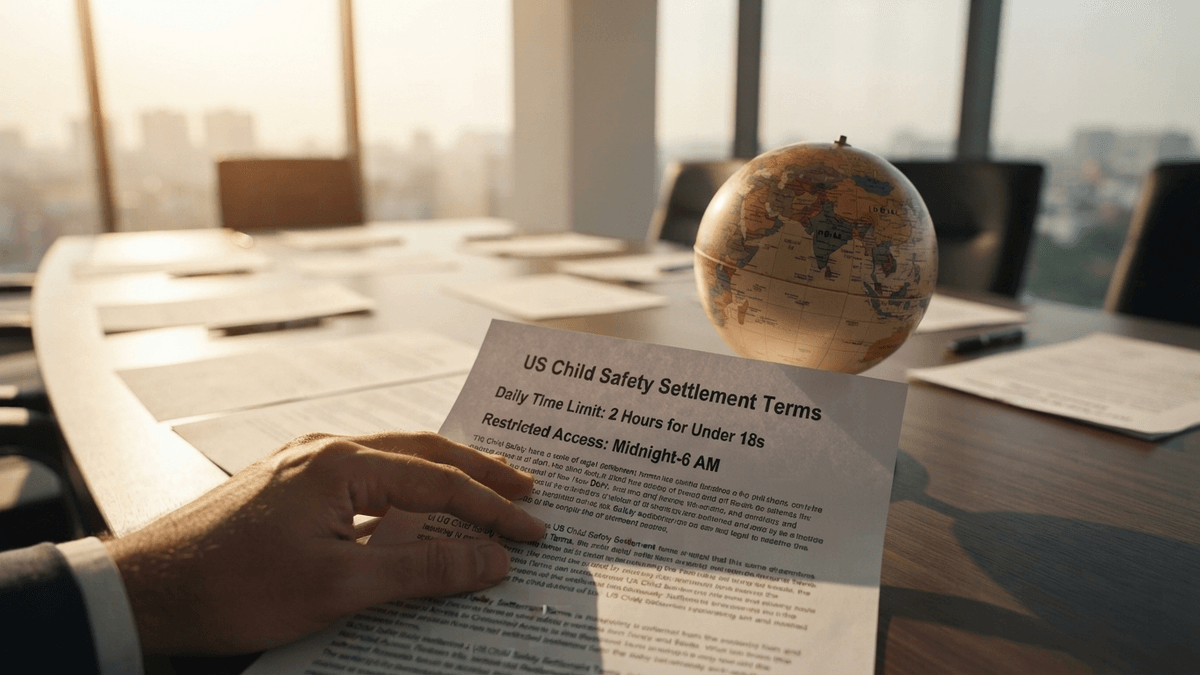
Document detailing US child safety settlement terms next to a globe showing India.
Meta has agreed to a substantial $18 billion settlement to resolve lawsuits in the United States that alleged harm to minors through its platforms, Facebook and Instagram. This agreement mandates significant changes to enhance online child safety within the US. However, the settlement’s lack of extraterritorial commitments has sparked debate regarding the protection of minor users in other major markets, particularly India, which represents Meta’s largest user base.
The settlement’s terms include a daily time limit of two hours for users under 18 on Facebook and Instagram, with access restricted between midnight and 6 AM. Additional measures involve adjusting notifications during school hours, limiting the use of extreme makeup filters, hiding like counts, and offering a non-algorithmic feed option. These defaults, while a significant step for US users, do not automatically extend to international markets.
Cybersecurity experts and legal professionals argue that these enhanced safety measures should be applied globally, especially in markets like India. The current approach, where regulators often rely on content takedowns rather than proactive product design, leaves minor users in India without the same baseline protections afforded to their US counterparts. This disparity raises concerns about Meta’s commitment to a uniform standard of child safety across its platforms.
While some experts advocate for adopting US standards, others suggest that India should develop its own tailored safety measures, considering its unique social and cultural context. India is still in the process of establishing a comprehensive national framework for online safety, with some states exploring legislative actions. The US settlement, however, provides a potential blueprint for Indian policymakers to mandate similar protections on Meta’s products.
The settlement underscores a broader discussion on digital responsibility, highlighting the need for social media companies to ensure the safety of young users regardless of their geographical location. The question remains whether Meta will voluntarily extend these safety features beyond the US to its vast international user base.
About the Author