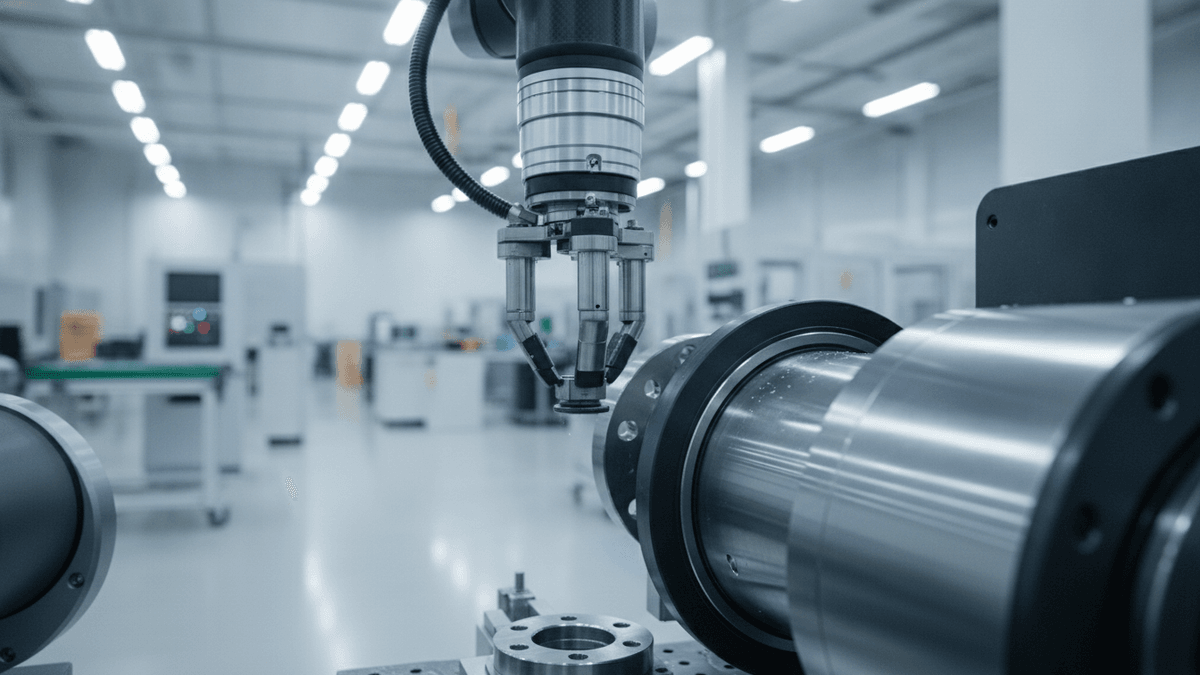
Robotic arm integrating precision industrial bearing accessories on assembly line.
The global bearing accessories market is set for substantial expansion, with a projected compound annual growth rate (CAGR) of 5.2% through 2035. This growth is largely fueled by the accelerating demand from the industrial automation and semiconductor sectors, according to a report by IndexBox Inc. The market’s index is anticipated to reach 165 by 2035, based on a 2025 benchmark of 100.
Bearing accessories, encompassing essential components like housings, flanges, locknuts, seals, and lubrication systems, are critical for the effective installation, operation, and maintenance of bearings across a wide spectrum of industrial applications. The aftermarket and replacement segment currently represents a significant portion of the market, accounting for 55-65% of the total demand, which indicates a robust and consistent revenue stream for manufacturers and suppliers.
Key factors driving this market expansion include the global surge in industrial automation and robotics adoption, increased investments in semiconductor and electronics manufacturing that necessitate high-precision accessories, and consistent replacement cycles in heavy industries, typically ranging from 5 to 7 years. A notable trend observed is the increasing preference among Original Equipment Manufacturers (OEMs) for integrated systems and modular sub-assemblies, aimed at streamlining assembly processes and mitigating quality risks. Furthermore, stringent certification requirements, such as ISO 9001 and IATF 16949, are contributing to the consolidation of the supply chain among established producers.
However, the market is not without its challenges. Volatility in the prices of raw materials like steel and alloys, which constitute 50-65% of production costs, poses a significant constraint. Price sensitivity, particularly in the standard-grade segments, alongside supplier qualification bottlenecks and the persistent issue of counterfeit products, also present hurdles for market participants.
The demand for bearing accessories is segmented across several key end-use industries. Industrial automation and instrumentation currently dominate, accounting for an estimated 35% of the market share, driven by the growth in robotics, conveyor systems, and CNC machinery. The electronics and optical systems segment, a rapidly growing area with annual growth rates of 6-8%, holds approximately 20% of the market. This segment is propelled by the trend towards miniaturization and the increasing demand for precision in consumer electronics and medical devices. The semiconductor and precision manufacturing segment, also experiencing 6-8% annual growth, represents 18% of the market, benefiting from global investments in chip manufacturing capacity and the need for ultra-clean, high-precision components.
Geographically, the Asia-Pacific region leads the market with an estimated 48% share, largely attributed to China’s substantial manufacturing capabilities and the rapid industrialization across other economies in the region. North America follows with approximately 22%, acting as a net importer of standard grades but maintaining strength in high-precision components, supported by manufacturing reshoring initiatives and significant investments in the semiconductor sector. Europe holds an 18% share, with a focus on premium, certified accessories for the automotive and aerospace industries. Latin America and the Middle East & Africa each contribute about 6%, with growth in these regions being driven by infrastructure projects and the mining and energy sectors, although both are heavily reliant on imports.
Major global players influencing pricing, capacity, and product development in the bearing accessories market include SKF Group, Schaeffler AG, NSK Ltd, NTN Corporation, JTEKT Corporation, and Timken Company.
About the Author