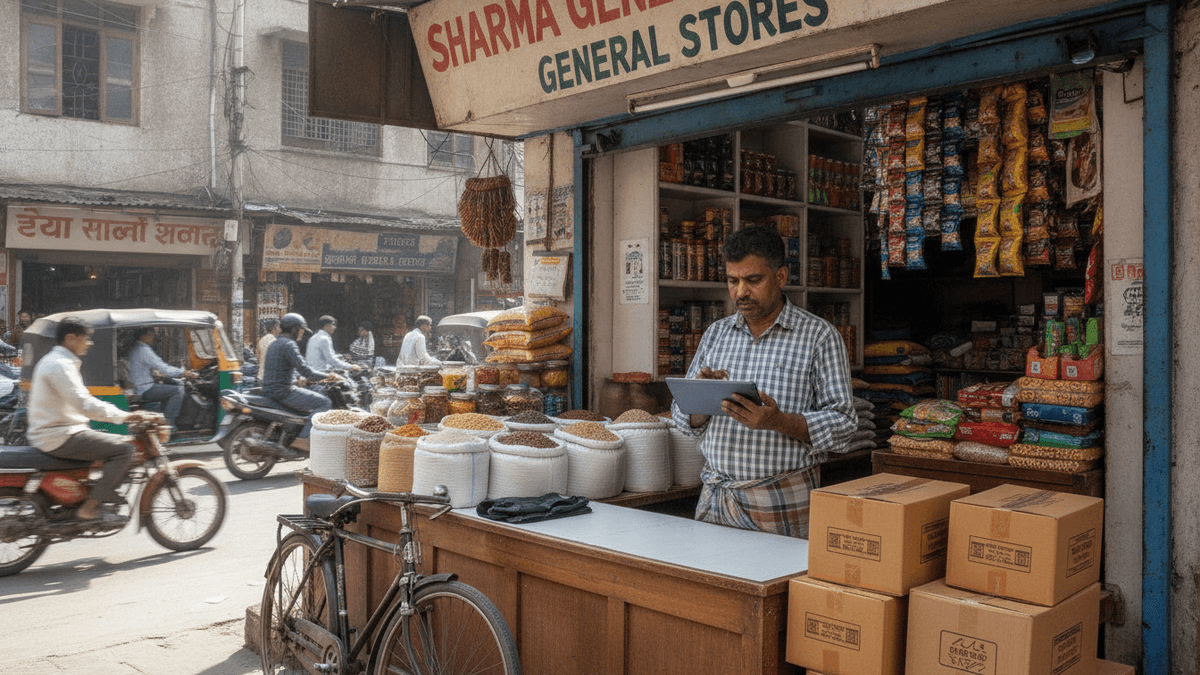
Indian kirana store owner managing operations with a digital device on a bustling street.
India’s ubiquitous kirana stores, the backbone of neighborhood retail, have become the new focal point for major e-commerce and B2B companies. In recent months, significant acquisitions and strategic partnerships signal a shift in how these small, traditional stores are being integrated into the digital commerce ecosystem.
Meesho acquired Kirana Club, and Udaan acquired ShopKirana, while Flipkart and Walmart are expanding their own kirana-focused initiatives. These moves highlight a broader trend: established players are recognizing the immense value of the deeply entrenched relationships and trust kirana owners have within their local communities.
Traditionally viewed as independent retail channels, kiranas are now being positioned as vital links connecting brands, distributors, marketplaces, and consumers. This integration allows companies to leverage existing retail networks, bypassing the need to build extensive fulfillment infrastructure from scratch. As Pranav Pai, managing partner at 3one4 Capital, notes, quick commerce alone cannot reach all Indian consumers, making kiranas a crucial channel for extending reach and driving sales for digital-first brands.
The value proposition extends beyond mere shelf space. Companies are acquiring access to the trust and local demand intelligence that kirana owners possess. Yash Bansal, co-founder of Fairdeal.Market, emphasizes that building these merchant relationships takes years, making acquisitions a faster route to scale and market penetration.
This strategic convergence is transforming kiranas from simple neighborhood stores into multifaceted operational hubs. They are increasingly serving as fulfillment points, local inventory hubs, and last-mile delivery partners. The integration into digital ordering platforms and procurement systems also opens avenues for new financial services, including working-capital financing and inventory management.
The ultimate prize, however, is demand intelligence. By digitizing transactions and integrating kiranas into a mainstream data pipeline, companies can gain unprecedented insights into consumption patterns. This intelligence is crucial for customized solutions, demand forecasting, and optimizing supply chains. As Ashish Jain of Waterbridge Ventures points out, solving the problem of ‘data darkness’ through this convergence can unlock new business models and services, fundamentally reshaping India’s retail landscape.
The battle for India’s kirana stores is not just about capturing market share; it is about building a comprehensive intelligence layer that can drive efficiency, personalization, and growth across the entire commerce value chain.
About the Author