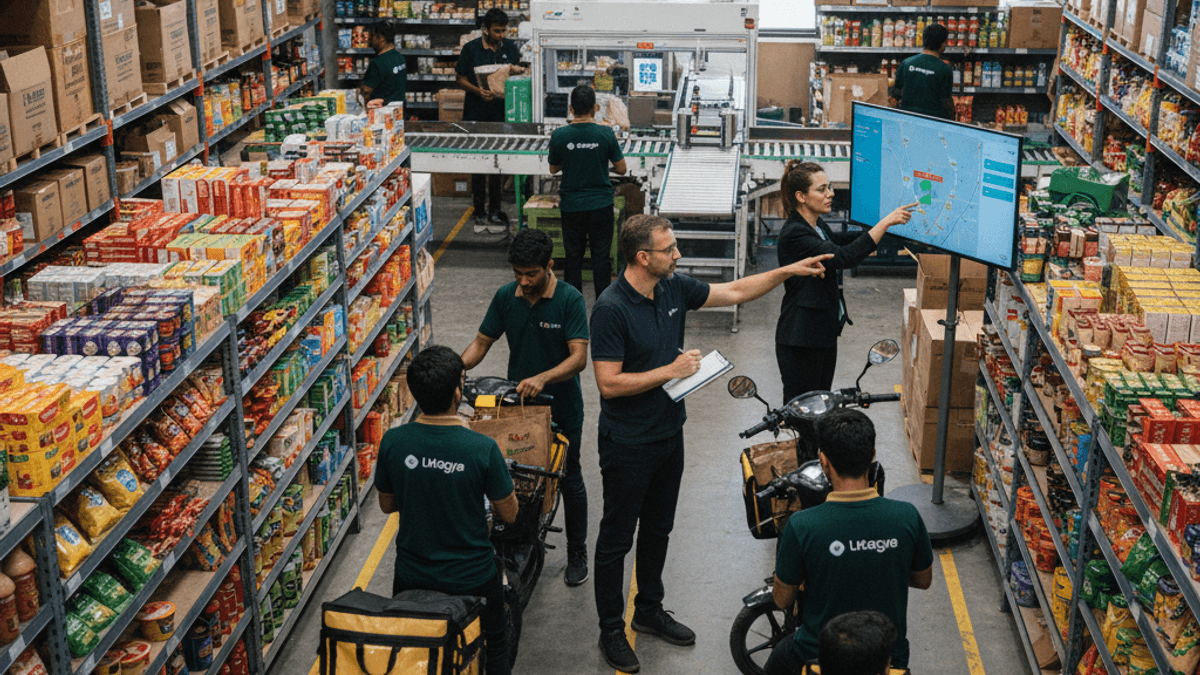
A bustling Eternal dark store, with a manager reviewing logistics on a screen while employees prepare orders.
Albinder Dhindsa has officially stepped into the role of group CEO at Eternal, effective February 1, 2026, inheriting a company that has grown significantly under Deepinder Goyal’s 18-year leadership. As Dhindsa navigates his first quarterly results, the company’s Q4 FY26 performance reveals a complex profitability picture, despite a substantial surge in net profit to ₹174 Cr, a 4.5X increase year-on-year.
While operating revenue jumped 196% year-on-year to ₹17,292 Cr, the underlying profitability is being bolstered by ₹342 Cr in other income. Excluding this, Eternal would have reported a loss for the quarter. This reliance on non-operating income, coupled with a massive 185% year-on-year increase in total expenses to ₹17,406 Cr, signals a structural tension as the company balances its three core verticals.
Eternal’s strategy hinges on three distinct bets: quick commerce (Blinkit), food delivery (Zomato), and the nascent going-out platform (District). Blinkit, while driving scale with a net order value of ₹14,386 Cr in Q4 FY26, reported a slim adjusted EBITDA of ₹37 Cr, indicating minimal margins despite near doubling of its net order value. The growth appears to stem from expanding user base and store network rather than increased revenue per customer or store.
The food delivery segment, Zomato, continues to provide steady revenue and stable contribution margins, but the company is prioritizing absolute profit growth over margin percentage, reinvesting gains back into the business. This strategy, while aimed at increasing revenue per order, keeps the average order value under pressure as the company explores lower minimum order values for price-sensitive customers.
District, the company’s third vertical, is still in its early stages, reporting an adjusted EBITDA loss of ₹81 Cr in Q4 FY26 on a net order value of ₹2,736 Cr. While losses have decreased quarter-on-quarter, the occasional nature of its business, dependent on events and discretionary spending, presents significant volatility. Eternal is focusing on improving execution and unit economics for District, rather than immediate growth acceleration.
Analysts remain cautiously optimistic, with several brokerages retaining positive ratings while acknowledging the need for greater profitability. The company has set an ambitious target of $1 Bn in adjusted EBITDA by FY29, indicating a clear mandate for Dhindsa to achieve faster scale while building a more sustainable business model. The coming quarters will be crucial in determining if Eternal can translate its impressive top-line growth into consistent bottom-line profitability across its diverse portfolio.
About the Author