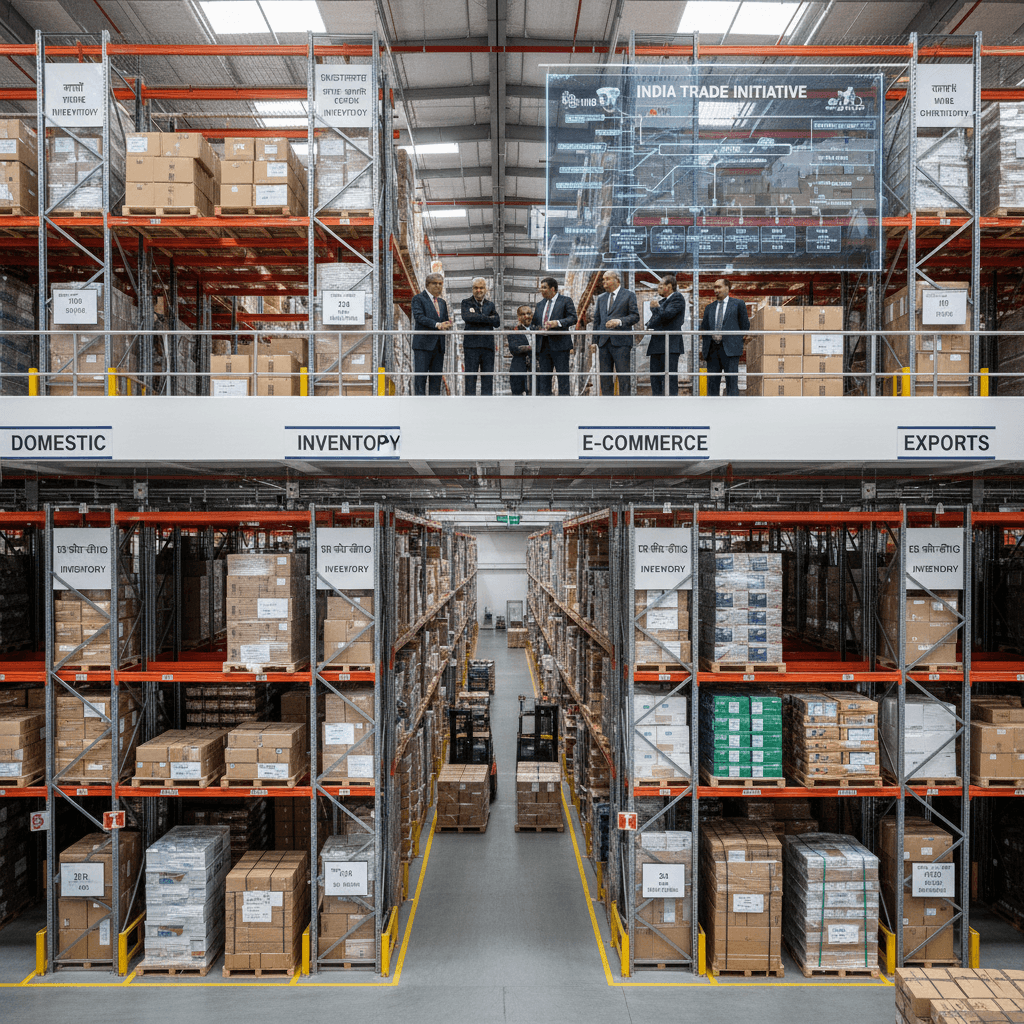
Government officials discuss e-commerce export policy in a large logistics warehouse.
The Indian government is considering requiring separate warehousing for domestic and international inventory in e-commerce, alongside allowing Foreign Direct Investment (FDI) in e-commerce exports, according to Inc42. Citing government sources, the Economic Times reports the proposed measure aims to prevent products intended for export from entering the domestic market.
Under the potential e-commerce export model, foreign-funded e-commerce firms would need to establish separate Indian entities to purchase goods from local sellers for international sales. Currently, India prohibits FDI in inventory-based e-commerce models, permitting it only in marketplace models. The proposed change seeks to boost Indian exports.
In the past year, the Ministry of Commerce and Industry sought feedback on allowing FDI in inventory-based e-commerce exclusively for exports. Amazon has previously requested amendments to FDI rules to enable direct purchases from Indian sellers for export purposes.
According to an Inc42 report, the Indian e-commerce sector is projected to exceed $400 billion by 2030. Investors favor the sector, with e-commerce startups raising $1.7 billion across 206 deals in 2025. EY reports that India has over 63 million MSMEs, contributing 43% of the country’s total exports. However, e-commerce exports account for only $4-5 billion, or 1% of total exports.
Allowing FDI in e-commerce exports could encourage companies to increase procurement from MSMEs, potentially boosting both Indian exports and the financial performance of these enterprises. Enhanced engagement with FDI-funded companies may also reduce compliance burdens for MSMEs.
The government has recently taken multiple steps to support MSMEs for job creation and to establish India as a global manufacturing hub. In the 2026-27 budget, Finance Minister Nirmala Sitharaman announced a dedicated ₹10,000 crore fund for SMEs to foster future growth. Additionally, the Self-Reliant India (SRI) Fund, launched in 2021, is slated to receive a ₹2,000 crore top-up to further support MSMEs and improve their access to risk capital.
About the Author