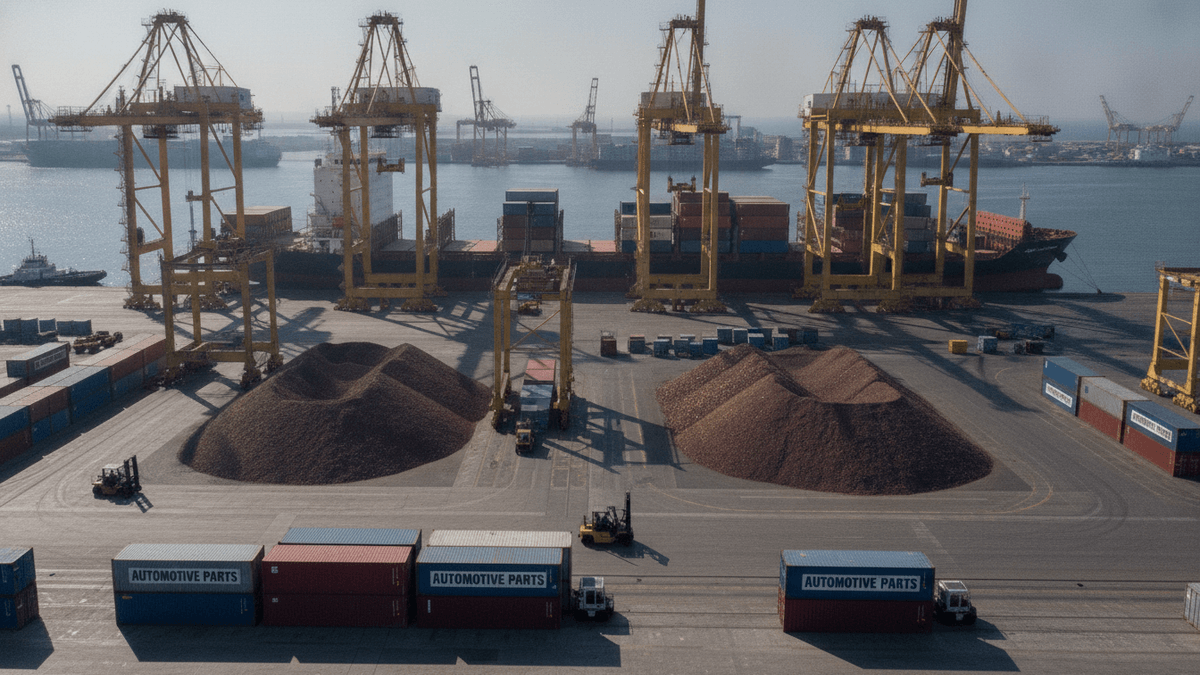
Port terminal with raw copper ore, automotive parts containers, and cargo ship.
India and the Southern African Customs Union (SACU), comprising South Africa, Botswana, Namibia, Lesotho, and Eswatini, have signed Terms of Reference (ToRs) to initiate negotiations for a Preferential Trade Agreement (PTA). This move signals a renewed effort to deepen economic ties, following previous trade discussions that stalled between 2002 and 2010.
The proposed PTA is expected to provide India with preferential access to crucial minerals such as platinum-group metals, manganese, and copper, which are vital for its manufacturing sector, including battery production and clean energy technologies. Concurrently, India aims to secure tariff concessions for its exports in key sectors like automobiles, pharmaceuticals, and industrial machinery.
This agreement represents a significant step for India, potentially marking its first major trade pact with an African regional bloc. It offers Indian businesses preferential entry into a market of approximately 65 million consumers and aims to facilitate increased exports from SACU nations to India, one of the world’s fastest-growing economies.
Commerce Minister Piyush Goyal expressed optimism for a swift conclusion of a mutually beneficial agreement. In the fiscal year 2025-26, India’s exports to SACU totaled $7.5 billion, with imports at $9.2 billion, resulting in a trade deficit for India. South Africa remains India’s largest trading partner within SACU, with bilateral trade reaching $15.56 billion in the same period.
India’s primary exports to South Africa include vehicles and components, transport equipment, pharmaceuticals, and engineering goods, while imports from South Africa are dominated by gold, steam coal, and various ores and minerals. Trade figures with other SACU members like Botswana and Namibia also show substantial exchange, particularly in diamonds and mining-related commodities, though trade with Eswatini and Lesotho has seen a decline.
About the Author