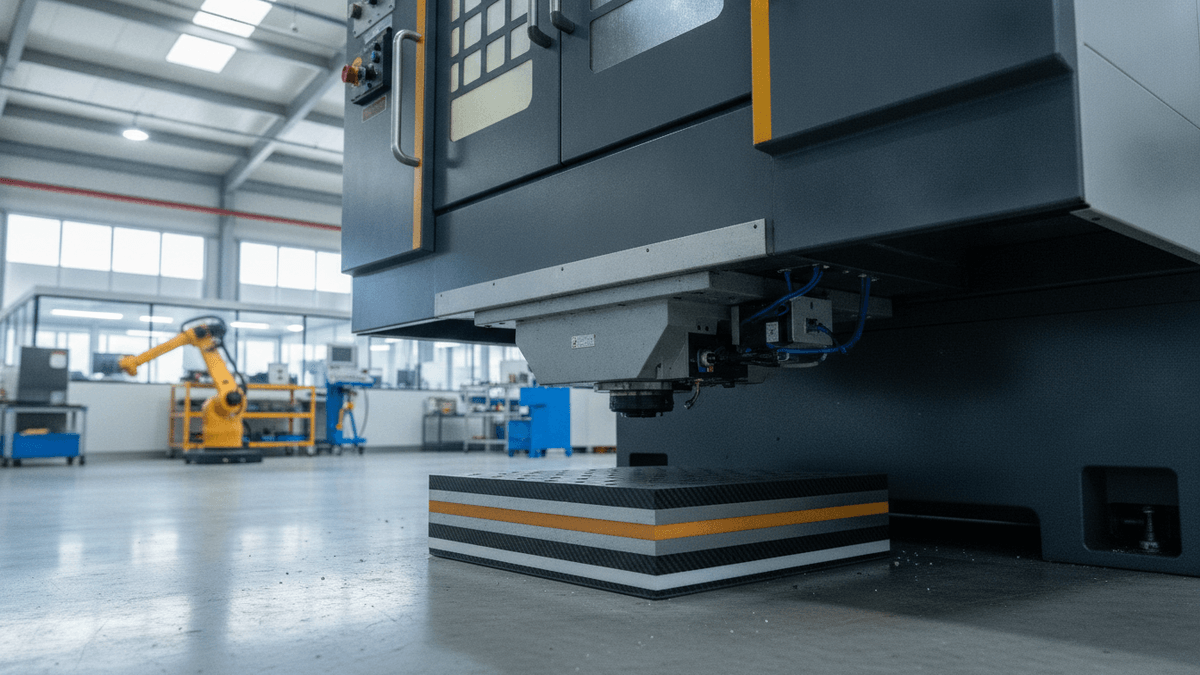
Composite anti-vibration pad supporting machinery in a Chinese manufacturing facility
The anti-vibration pad market in China is poised for substantial expansion, with projections indicating a 6–8% compound annual growth rate (CAGR) from 2026 to 2035. This anticipated growth is largely attributed to the accelerating pace of industrial automation, the significant investment in semiconductor manufacturing facilities, and the increasing stringency of regulations concerning noise and vibration control in urban infrastructure.
While rubber pads currently hold the largest market share, estimated at 45–55% of domestic volume, a clear trend towards advanced materials is emerging. Engineered composite and polyurethane pads are capturing a greater share, particularly in high-precision applications such as instrumentation and renewable energy sectors. These advanced materials offer superior performance characteristics compared to traditional felt and cork products.
Manufacturing of anti-vibration pads is concentrated in China’s key industrial hubs, the Yangtze River Delta and Pearl River Delta, which account for over 60% of national production. Despite this robust domestic capacity, the premium segment of the market continues to rely on imports for a significant portion (30–40%) of its value, especially for specialized high-damping elastomer compounds and marine-grade isolators.
The market operates primarily on a business-to-business (B2B) model, where procurement decisions are heavily influenced by technical specifications, including load ratings, deflection capabilities, and overall durability. Key market trends indicate a move away from commodity rubber pads towards more sophisticated engineered composite and spring isolators. The precision instrumentation and semiconductor equipment segments are expected to experience growth rates of 9–11% annually through 2035. Furthermore, China’s dual-carbon policy and electrification initiatives are expected to drive demand for pads with enhanced load-bearing capacity and fire-retardant properties, particularly in the power generation and HVAC sectors.
Challenges that could impact market growth include the inherent volatility of feedstock prices for raw materials like natural rubber and polyurethane, which constitute a substantial portion of variable production costs. Inconsistencies in the quality of mid-tier domestic products also present a challenge, leading to a bifurcated market. Additionally, the fragmented nature of provincial regulations can complicate compliance for suppliers operating across multiple regions.
By 2035, the market volume is expected to approximately double. Value growth is anticipated to outpace volume growth, driven by the increasing adoption of higher-value engineered solutions. Industrial machinery and HVAC systems remain the largest demand drivers, collectively representing 50–60% of the domestic market. Pricing structures vary considerably, ranging from RMB 8-45 per kilogram for standard rubber pads to significantly higher prices for precision instrumentation and marine-grade products.
The competitive landscape is characterized by a mix of numerous small regional fabricators, specialized mid-sized manufacturers, and international brands operating through local joint ventures. China is a notable importer of high-end anti-vibration pads from countries such as Germany, Japan, the United States, and South Korea, while also being a significant exporter of commodity-grade pads globally. Distribution channels are diverse, involving MRO distributors and online B2B platforms for standard products, and direct sales for specialized, engineered solutions.
Evolving national environmental protection laws and building codes are increasingly influencing demand for vibration isolation solutions. Future opportunities are expected in the premium and engineered segments, particularly for applications in semiconductor equipment, precision metrology, and marine engine mounting. The retrofit market, inland provincial development, green building products, and the integration of smart sensors into pads also present promising avenues for growth, alongside the expansion of export markets.
About the Author