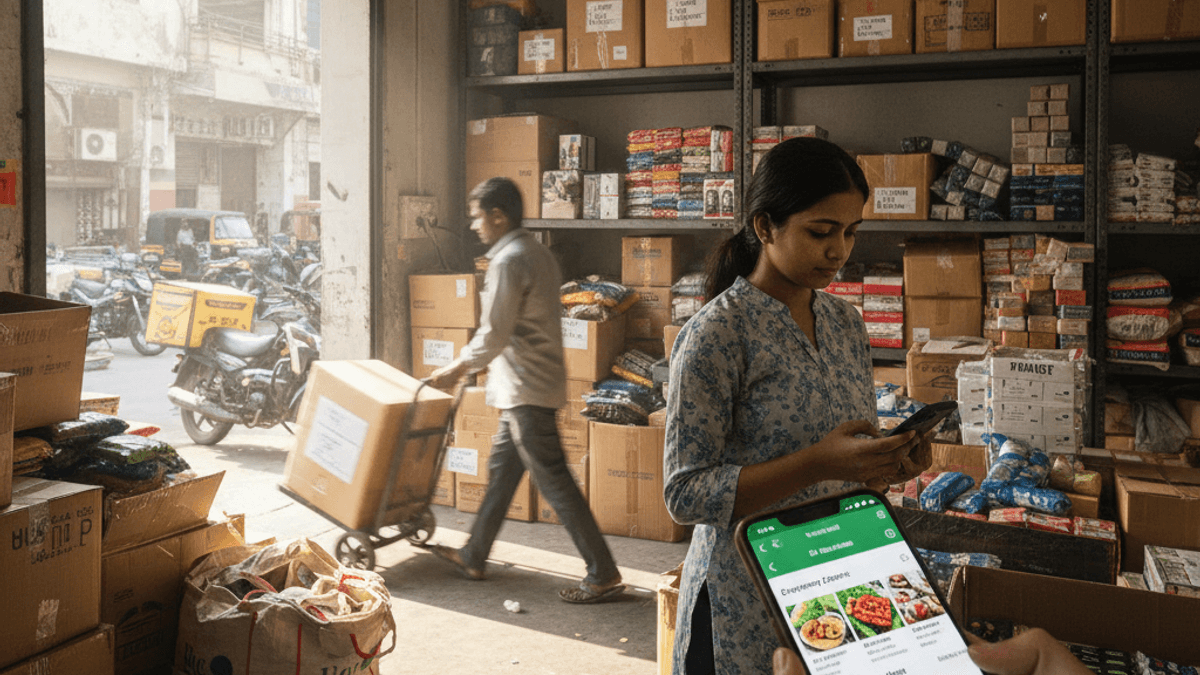
A woman processes e-commerce orders in a bustling Indian warehouse.
India’s e-commerce sector is undergoing a significant transformation, evolving from a mere online shopping channel to a fundamental driver of the country’s retail landscape. According to Inc42 Datalabs’ ‘D2C 3.0: The Next Big Wave in Indian Ecommerce Report 2026,’ the market is expected to expand from its current valuation of $165 billion to $450 billion over the next five years, driven by a compound annual growth rate (CAGR) of 22%.
This digital acceleration is set to elevate e-commerce’s share of India’s total retail gross merchandise value (GMV) to nearly 22% by 2031, a notable increase from the current 12%. This expansion is largely attributed to a structurally under-penetrated retail system, where despite India’s vast $4 trillion retail market, only about 12-15% is organized. Historically, high real estate costs and inefficient distribution networks limited modern retail to major urban centers.
However, e-commerce platforms such as Amazon, Flipkart, and Reliance’s JioMart have democratized access, enabling brands to reach Tier II and Tier III markets effectively. The Direct-to-Consumer (D2C) segment is a key growth engine, with brands like Mamaearth, boAt, Lenskart, and Sugar Cosmetics increasingly adopting omnichannel strategies that include offline retail and exclusive brand outlets.
Investment activity reflects this trend. Between 2015 and Q1 2026, D2C startups secured over $10 billion across 1,400 deals. Investor interest is particularly strong in seed and growth-stage funding, aiming to identify the next generation of leading brands.
While fashion, beauty, and electronics remain dominant categories, grocery and household essentials are gaining traction, propelled by the rise of quick commerce. Companies like Zomato (through its acquisition of Blinkit) and Swiggy (with Instamart) are investing heavily in this space. Zepto’s rapid scaling and potential IPO further underscore the investor appetite for quick commerce.
Despite the significant growth potential, challenges persist. A small fraction of power shoppers currently drives a substantial portion of e-commerce GMV, and the broader user base remains price-sensitive. Success in India’s evolving e-commerce economy will likely hinge on wide margins and effective pricing strategies.
The ongoing retail reset in India presents a dynamic landscape, with significant opportunities for well-positioned e-commerce players to capture market share.
About the Author