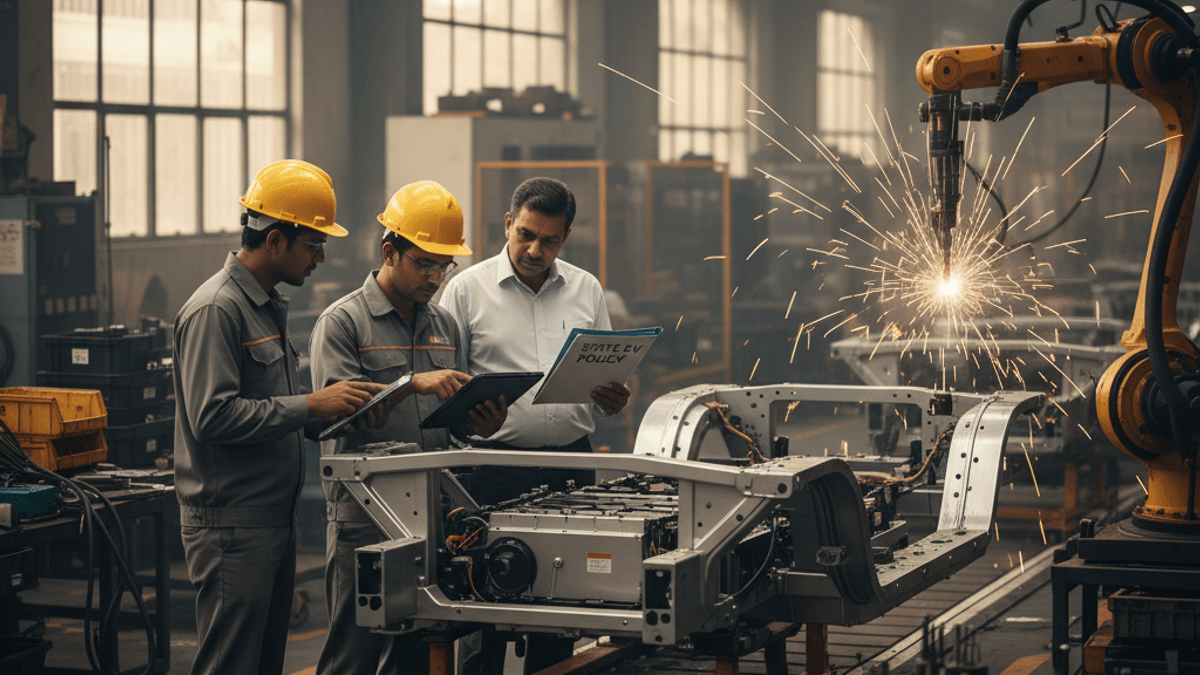
Engineers review plans for EV manufacturing amidst welding sparks in an Indian factory.
New Delhi – India’s ambitious push to become a global hub for electric vehicle (EV) manufacturing faces a crucial dependency on the nuanced design of state-level policies, according to a recent report by the International Institute for Sustainable Development (IISD).
The report warns that while the widespread adoption of EVs could significantly reduce India’s reliance on imported oil, a lack of robust local manufacturing capabilities risks increasing dependence on imported components. This, in turn, could expose the country to supply chain vulnerabilities and exacerbate trade deficits.
IISD’s analysis suggests that without a strategic and coordinated approach to policy formulation at the state level, India may miss a critical opportunity to build a self-sufficient and competitive EV manufacturing ecosystem. The effectiveness of incentives, regulatory frameworks, and infrastructure development within each state will be pivotal in attracting investment and fostering domestic production.
The findings underscore the need for policy coherence across different states to create a predictable and attractive investment climate for both domestic and international players in the EV sector. Failure to address these policy design elements could undermine the broader economic and environmental goals associated with the EV transition.
About the Author