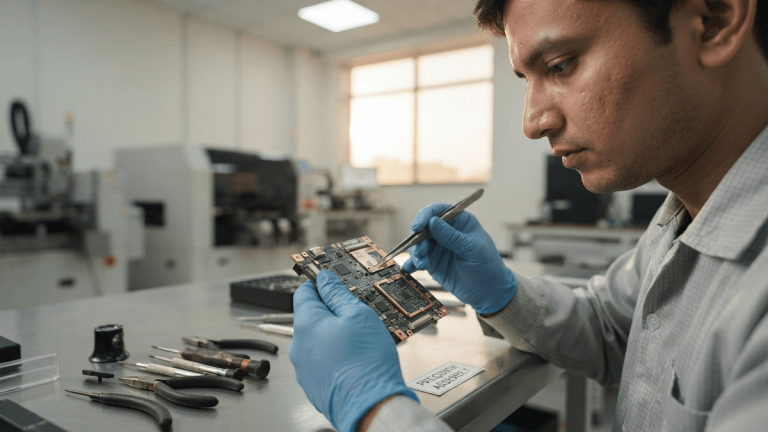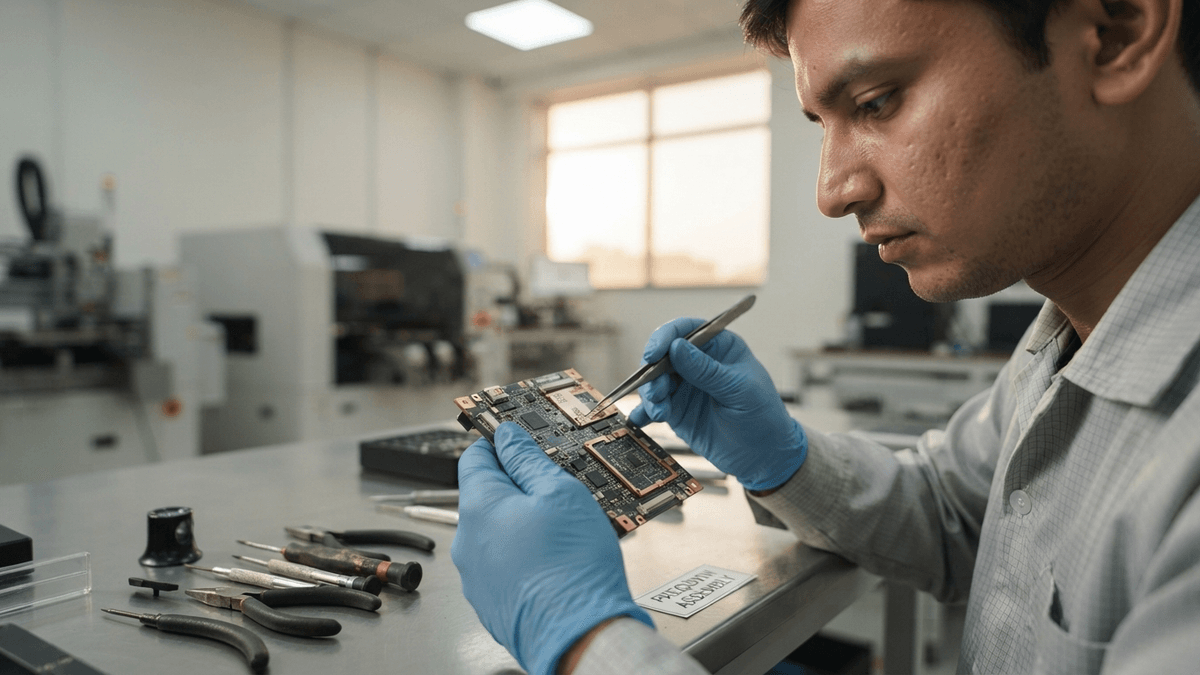
A technician assembles a high-value circuit module in an Indian manufacturing facility.
India is undergoing a structural transition in its industrial sector, moving away from simple assembly operations toward integrated, high-value manufacturing ecosystems. This evolution, supported by the ‘Make for India’ initiative, is increasingly attracting institutional capital and private equity interest as the country positions itself as a critical node in global supply chains.
The strategic shift is driven by a convergence of factors: a robust domestic market, a growing pool of specialized engineering talent, and favorable government policy, including Production Linked Incentive (PLI) schemes. Unlike previous iterations of industrial growth, current efforts focus on domestic value addition and localized supply chain resilience.
For private equity and venture capital investors, this transition presents a shift in opportunity. Rather than focusing solely on consumer-facing digital platforms, capital is increasingly flowing into industrial automation, advanced manufacturing, and component localization. This shift suggests a long-term play on India’s ability to capture higher margins in the global manufacturing value chain.
However, the transition remains dependent on continued infrastructure development and the scaling of skilled labor. As global firms look to diversify operations beyond existing hubs, India’s ability to demonstrate consistent, high-quality production at scale will be the primary determinant in attracting further institutional capital inflows in the coming decade.
About the Author