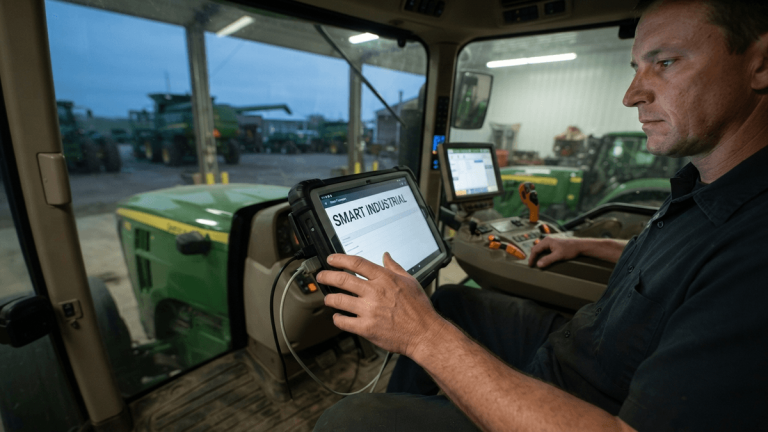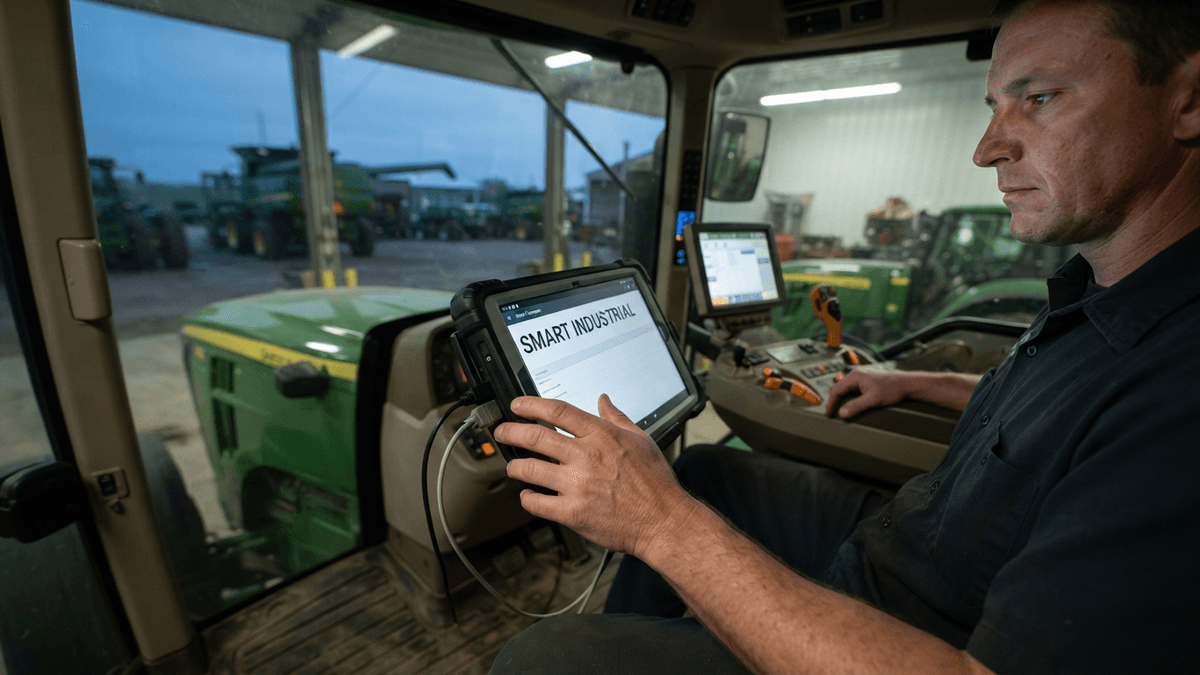
A technician monitors data within a Deere & Company tractor cab.
Deere & Company (NYSE: DE) is increasingly viewed by institutional investors not merely as a traditional heavy machinery manufacturer, but as a key player in the industrial technology sector. The company’s strategic pivot under its ‘Smart Industrial’ framework marks a concerted effort to decouple its valuation from the cyclical nature of agricultural commodity prices by layering high-margin digital services onto its hardware base.
By integrating artificial intelligence, robotics, and data analytics into its product lines, Deere is facilitating a transition toward precision agriculture. This shift allows farm operators to optimize crop yields and reduce input costs through autonomous machinery and real-time data monitoring. For the private and institutional investment community, this development represents a significant evolution in the company’s capital allocation strategy, prioritizing software-as-a-service (SaaS) models alongside traditional equipment manufacturing.
Despite persistent macroeconomic headwinds and volatility in global agricultural demand, Deere’s focus on technological integration has bolstered its balance sheet resilience. The company’s ability to maintain margins through digital subscription models and automated solutions provides a defensive moat against the cyclical downturns typically associated with the agricultural equipment industry. As industrial firms continue to face pressure to digitize legacy operations, Deere’s trajectory serves as a benchmark for how established manufacturers can successfully scale innovation to sustain long-term investor appeal.
About the Author