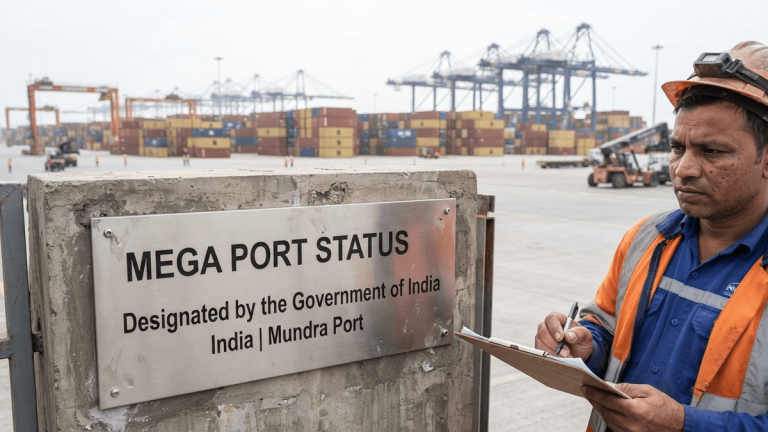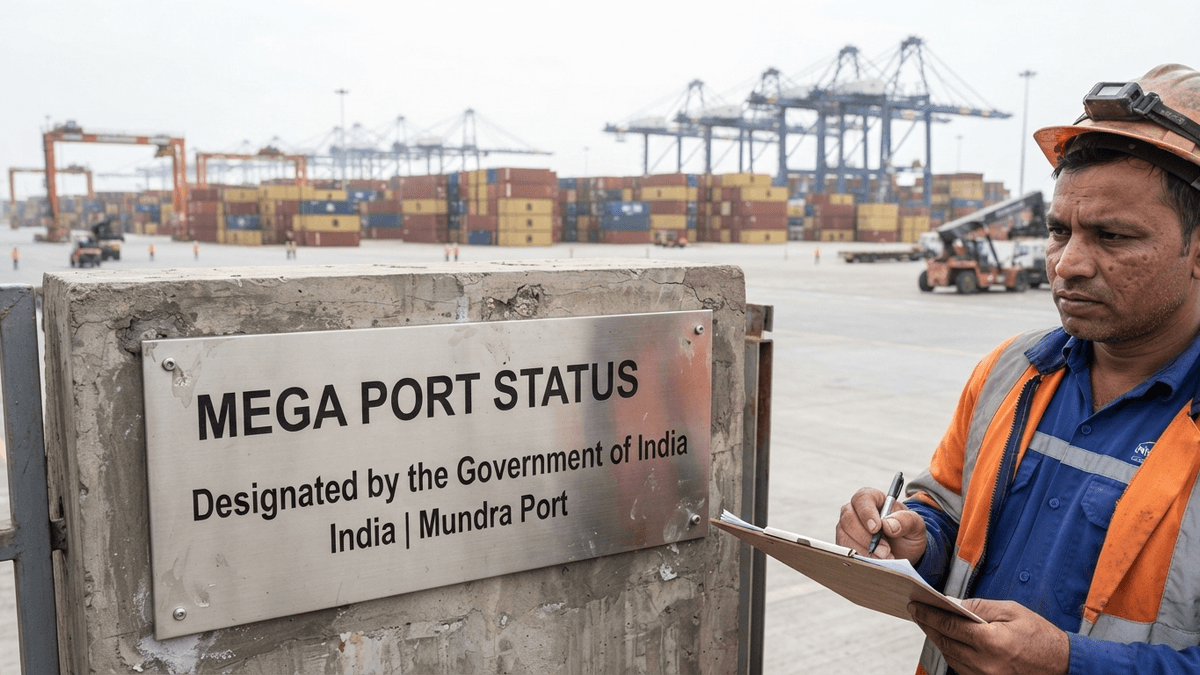
A plaque at Mundra Port signifies its designation as one of India's four new mega ports.
The Indian government has officially introduced a new ‘mega port’ designation, formalizing a strategic classification for the nation’s most critical maritime infrastructure. The four initial ports to receive this status are Deendayal (Kandla), Jawaharlal Nehru (Nhava Sheva), Paradip, and the Adani Group-operated Mundra port.
This classification, valid for an initial five-year term, is awarded based on stringent cargo handling performance metrics. To qualify, bulk ports must demonstrate an annual handling capacity of at least 150 million metric tonnes (MMT), while container ports must meet a threshold of 7.5 million twenty-foot equivalent units (TEUs). By establishing these benchmarks, the government aims to consolidate trade efficiency and incentivize higher throughput across the national logistics network.
For institutional investors and private equity firms active in India’s logistics and infrastructure sectors, this policy move signals a shift toward prioritizing high-capacity, high-efficiency hubs. Mundra, India’s largest private port, remains the only non-major port to be included in this select group, underscoring the government’s willingness to integrate private sector operators into its national logistical framework.
The policy is expected to streamline regulatory processes and potentially attract further private capital into port infrastructure expansion. As India seeks to reduce its logistics costs to improve global trade competitiveness, the ‘mega port’ status serves as a key lever for prioritizing capital allocation and infrastructure development over the coming half-decade.
About the Author