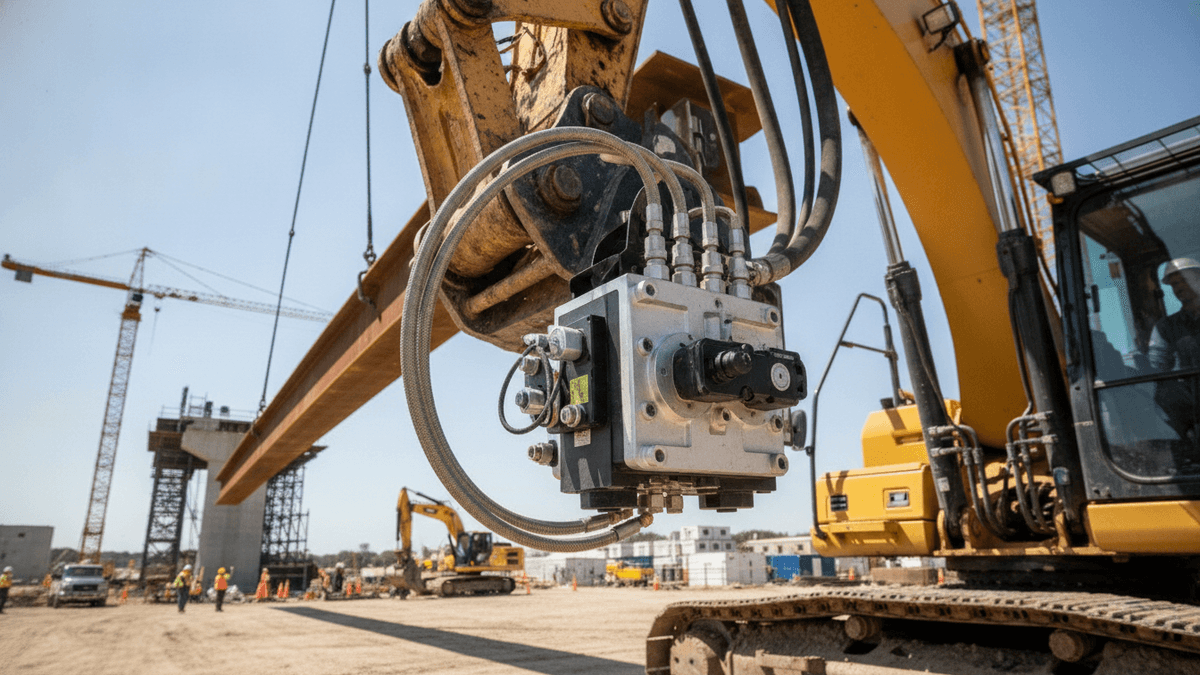
Hydraulic diverter valve on heavy machinery at a construction site
The global market for Hydraulic Diverter Valves is anticipated to witness robust expansion, with projections indicating a compound annual growth rate (CAGR) of 4.5-6.0% between 2026 and 2035. This sustained growth is primarily attributed to increasing levels of mechanization in developing economies and the systematic replacement of aging hydraulic systems in more mature markets.
These valves are critical components in directing hydraulic fluid flow within both mobile and industrial machinery. Consequently, their market demand is closely tied to capital investment cycles across key sectors such as construction, agriculture, mining, and manufacturing. Industry analysis suggests that by 2026, mobile hydraulics will constitute a significant portion, estimated at 60-65%, of the global demand.
A notable evolution within the market is the increasing adoption of electro-hydraulic actuation and proportional control technologies. This trend is leading to the integration of diverter valves into more sophisticated, automated, and sensor-rich platforms. Furthermore, modular manifold-mounted cartridge valve configurations are gaining traction over traditional monoblock designs due to their inherent advantages in reducing assembly complexity and enhancing serviceability.
Key drivers fueling this market expansion include substantial global infrastructure spending, particularly in regions like Asia-Pacific, and the ongoing agricultural mechanization efforts in countries such as India and Brazil. The accelerated replacement of older equipment in North America and Europe, driven by mandates for improved emissions and efficiency standards, also contributes significantly to demand.
Despite the positive outlook, the market faces challenges, including volatility in raw material costs for components like steel castings and aluminum, which can impact profit margins. Additionally, lengthy technical qualification periods for new suppliers, often spanning 12-18 months for critical applications, present barriers to entry.
The demand for hydraulic diverter valves is segmented across various end-use industries. Construction and Mining Equipment represent the largest segment at 35%, followed by Agricultural Machinery at 25%, and Industrial Automation and Manufacturing at 20%. Material Handling and Logistics account for 12%, with Oil and Gas, Marine, and Other Heavy Industries making up the remaining 8%.
Geographically, Asia-Pacific is the dominant market, holding an estimated 42% share, largely propelled by China’s rapid urbanization and infrastructure development. North America follows with 24%, supported by infrastructure investments and fleet modernization initiatives. Europe accounts for 22%, driven by stringent environmental regulations and industrial automation trends. Latin America and the Middle East & Africa represent smaller but growing markets, contributing 7% and 5% respectively.
Major global players influencing the market landscape include Bosch Rexroth AG, Parker Hannifin Corporation, Eaton Corporation plc, Danfoss A/S, and Hydac International GmbH. These companies play a pivotal role in shaping pricing strategies, production capacities, and product innovation across the sector.
About the Author