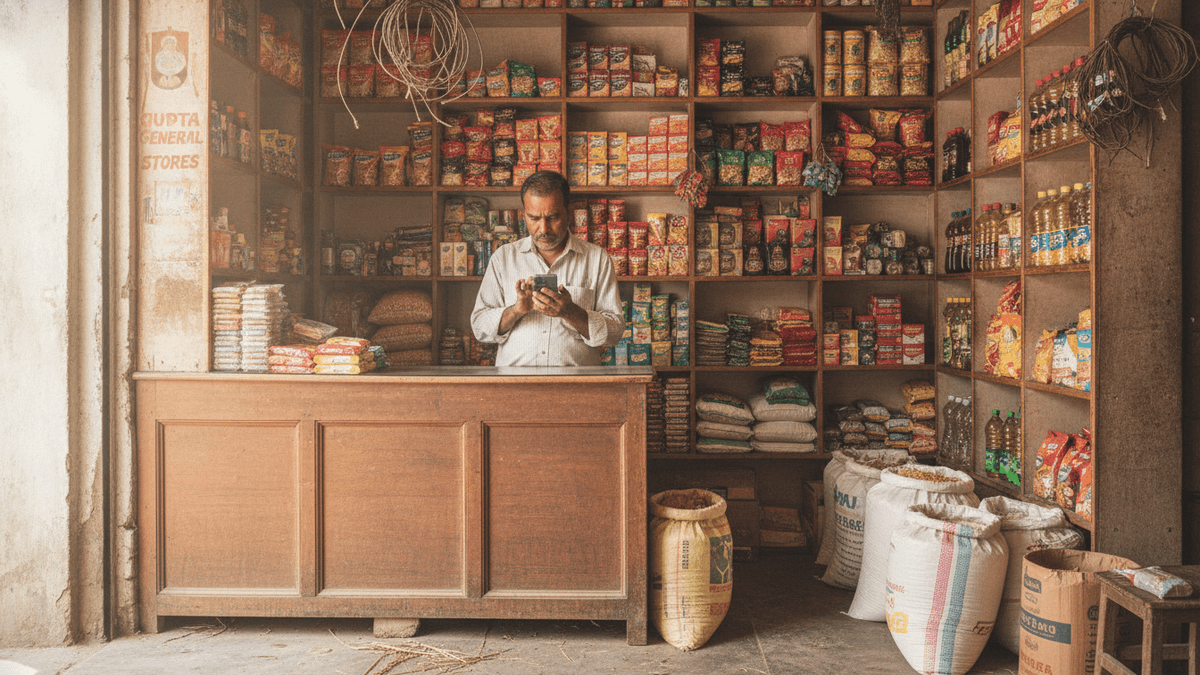
Kirana store owner views a mobile device in a traditional Indian shop.
E-commerce platform Meesho has announced its first acquisition, purchasing B2B retail startup Kirana Club for ₹202 crore. This move marks Meesho’s strategic expansion from its traditional B2C e-commerce model into the business-to-business (B2B) retail space in India.
The acquisition, valued at 200 times Kirana Club’s projected FY26 topline of ₹33 Lakh, highlights Meesho’s ambition to tap into the growing kirana commerce sector. Vidit Aatrey, CEO of Meesho, indicated plans for further expansion opportunities within the B2B retail landscape.
This development occurs amidst a challenging period for India’s B2B kirana commerce sector, where established players like Udaan and ElasticRun have recently undergone significant valuation markdowns. Udaan’s valuation has fallen approximately 59% from its peak, while ElasticRun saw its valuation halved. These companies have focused on narrowing losses, often at the expense of revenue growth, indicating ongoing challenges in achieving sustainable unit economics.
Kirana Club operates an asset-light model, focusing on a zero-inventory and zero-field sales approach. It functions as a marketplace connecting kirana store owners directly with FMCG brands, differentiating itself from earlier B2B platforms that relied heavily on warehousing and extensive on-ground sales teams.
The platform’s mobile-first approach includes community features where retailers share pricing information and discuss products, fostering trust and retention among small-town retailers. Kirana Club specifically targets underserved kirana stores in Tier III and IV, and rural markets, where brand sourcing has historically been fragmented.
Industry analysts suggest Meesho aims to integrate Kirana Club’s retailer network with its existing ecosystem of logistics, payments, and creator-commerce businesses. The company’s logistics arm, Valmo, is expected to provide crucial fulfillment infrastructure, potentially reducing operational costs and bottlenecks that have plagued other B2B kirana platforms.
While the B2B kirana space has seen consolidation and valuation adjustments, investors like Gaurav Chaturvedi of Kae Capital believe the market timing and economics are now more favorable. He notes that retailers are more accustomed to digital interfaces, and newer models focusing on network effects rather than pure supply chain digitization may prove more successful.
The acquisition’s strategic rationale also hinges on the higher profit margins available in categories beyond groceries and electronics, such as home supplies and fashion, which are often stocked by kirana stores in smaller towns. Furthermore, the rise of quick commerce has increased FMCG brands’ openness to partnering with established B2B players.
Despite the potential synergies, questions remain about the 200x revenue multiple paid for Kirana Club, given its early stage and competition from well-capitalized rivals. Meesho has yet to detail the full integration plans, emphasizing a strategy that leverages its broader ecosystem rather than relying solely on logistics.
About the Author