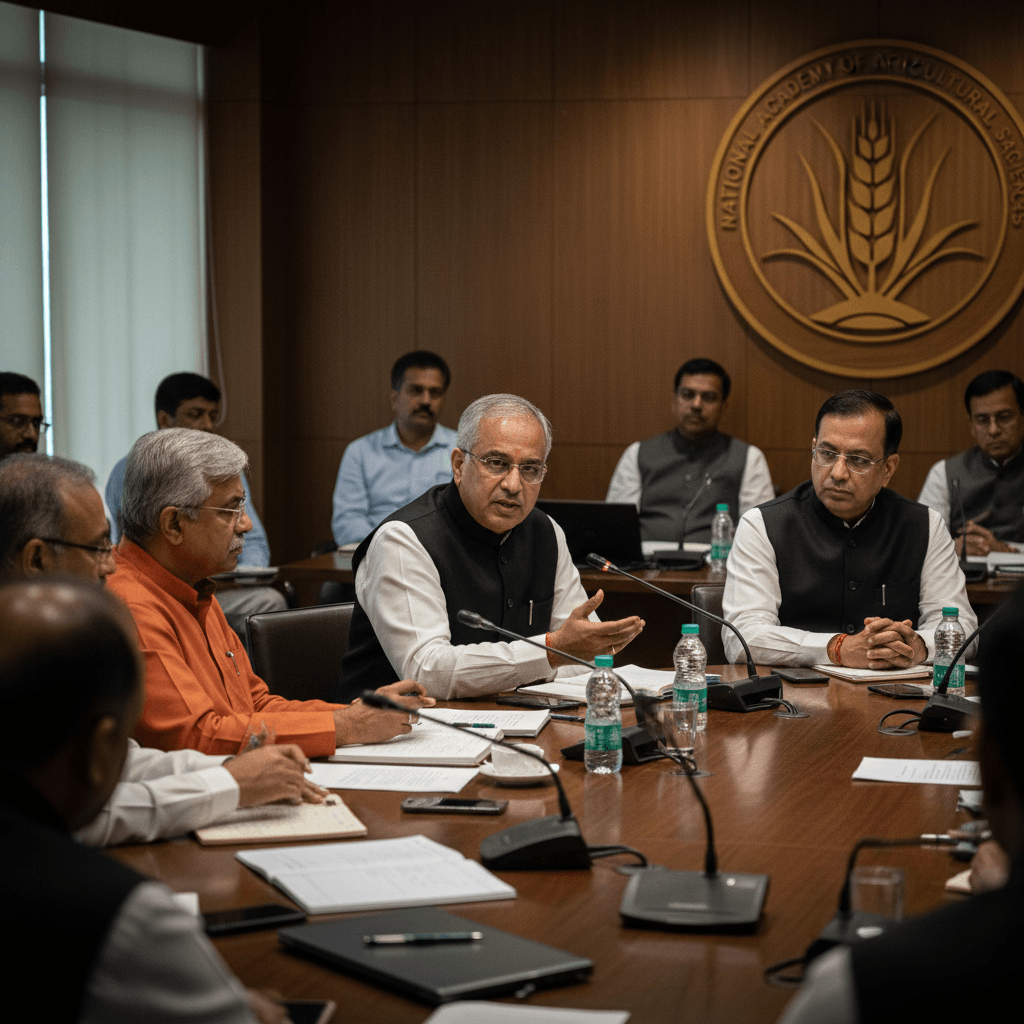
Government officials and agricultural experts discussing policy at a long table.
India is aiming for self-reliance in fertilizer production through a strategic roadmap developed by the National Academy of Agricultural Sciences (NAAS). The initiative focuses on reducing the country’s reliance on imported fertilizers, particularly phosphorus and potassium, which constitute a significant portion of India’s 33 million tonnes of annual fertilizer consumption.
The roadmap, formulated during a high-level brainstorming session, emphasizes policy overhauls and a shift towards sustainable nutrient management. Key participants included government officials, academics, fertilizer industry representatives, and farmer groups. M. L. Jat, Secretary of the Department of Agricultural Research and Education, highlighted the importance of agricultural transformation for achieving a self-reliant India by 2047.
Currently, India’s fertilizer consumption is skewed towards subsidized urea, leading to inefficient nutrient use, declining productivity, and environmental concerns. Fertilizer subsidies are projected to reach approximately Rs 1.71 lakh crore in 2024–25.
The NAAS roadmap proposes several measures, including:
- Strengthening soil health management
- Promoting balanced fertilizer application
- Enhancing farmer awareness
- Integrating technologies like AI and precision nutrient management
- Utilizing indigenous resources such as phosphate rocks and industrial by-products
- Increasing the use of biological inputs
- Crop diversification
A key proposal is the ‘Integrated Nutrient Supply and Management (INSAM)’ program, which aims to replace 25% of mineral fertilizers with organic alternatives within three years. Policy reforms include bringing urea under the nutrient-based subsidy regime, repurposing subsidies to incentivize good agricultural practices, and linking benefits to soil health cards.
Experts suggest direct cash transfers of fertilizer subsidies to farmers to promote more judicious use and re-evaluation of India’s fertilizer policies in light of global supply uncertainties.
This initiative signifies a strategic shift towards sustainable, efficient, and self-reliant nutrient management systems, crucial for India’s economic future and agricultural transformation.
About the Author