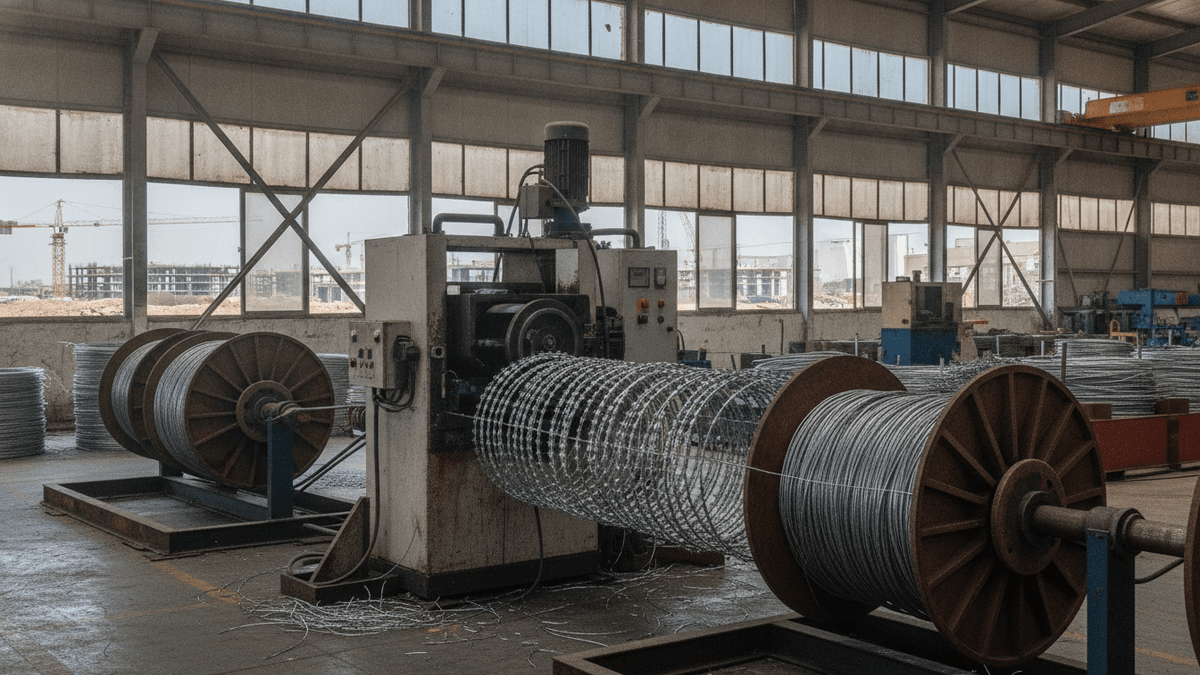
Barbed wire machine manufacturing concertina wire in a Saudi Arabian factory.
The market for barbed wire machines in Saudi Arabia is set for robust expansion, with projections indicating high single-digit annual growth through 2035. This growth is largely propelled by the Kingdom’s ambitious Vision 2030 initiatives, which include significant developments in industrial cities, expansions of oil and gas facilities, and programs to enclose agricultural lands. The market, currently over 70% import-dependent, primarily sources machinery from China, Turkey, and Europe.
Key trends shaping the sector include a strong shift towards fully automatic and CNC-controlled machines capable of producing concertina and razor wire. There’s also an increasing demand for machines integrating galvanized wire processing lines and a growing adoption of digital monitoring and predictive maintenance technologies. Despite these advancements, the market faces challenges such as supply chain disruptions for high-tensile steel wire and a shortage of skilled technical personnel for machine maintenance.
The total addressable machine population in Saudi Arabia is estimated between 450-600 units, with an annual demand for new and replacement machines ranging from 60 to 90 units. Fully automatic machines dominate the market, accounting for 50-60% of demand. Industrial perimeter security for oil and gas facilities is the largest application, driving 40-50% of machine demand, followed by border/military fencing (20-25%) and agricultural fencing (15-20%). Government and state-owned enterprises are the primary consumers, representing 55-65% of total demand.
Pricing for mid-tier automatic machines varies between USD 45,000 and USD 85,000, while premium systems can range from USD 120,000 to USD 200,000. Import duties and logistics typically add 12-18% to the landed cost. Chinese suppliers lead the market by volume (45-55%), followed by Turkish (20-25%) and European manufacturers (15-20%). Domestic production remains limited, supplying less than 15% of the annual demand.
Imports are crucial, making up over 85% of annual installations by value. Regulatory compliance, including SASO certification and adherence to Saudi Building Codes and Saudi Aramco’s SAES standards, is a key consideration for market participants. The forecast suggests a compound annual growth rate of 6-9% in volume and 7-10% in value through 2035. Opportunities for market players lie in localizing machine assembly, enhancing aftermarket services and spare parts availability, and developing IoT-enabled services for smart manufacturing.
About the Author