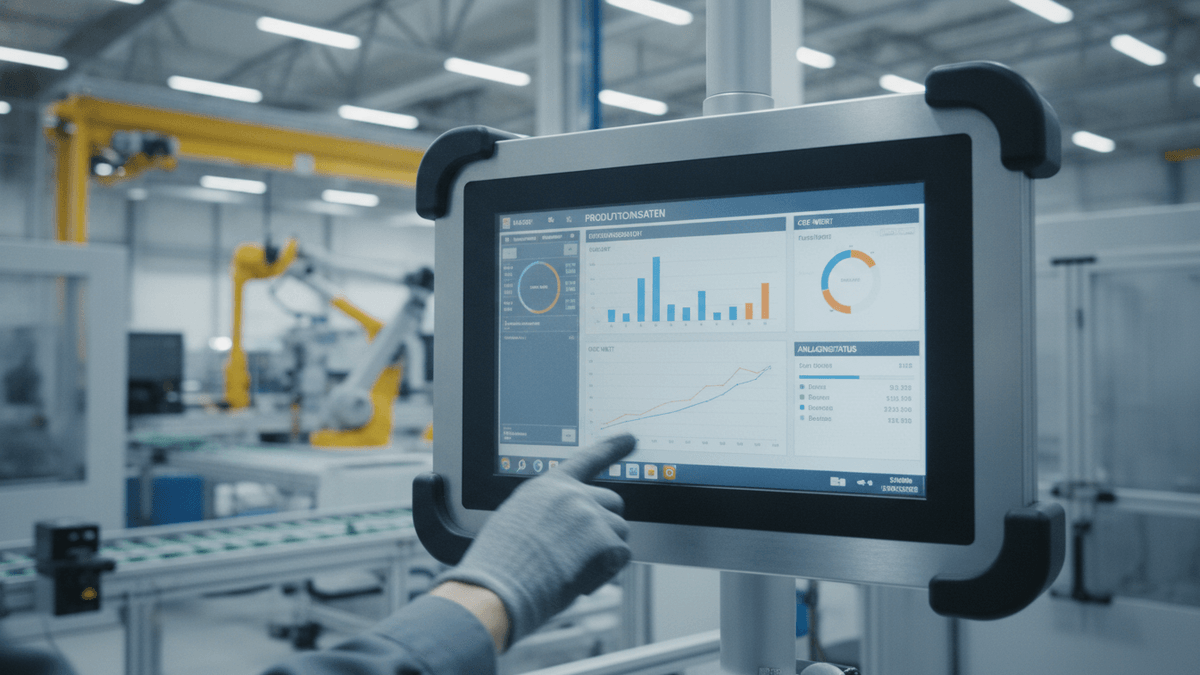
Industrial touch monitor displaying real-time production data in a German factory
The German industrial touch monitor market is expected to experience mid-single-digit annual growth through 2035, with total unit demand projected to increase by 35–50% between 2026 and 2035. This expansion is primarily driven by the ongoing digital transformation within the country’s robust manufacturing sector, particularly in discrete manufacturing, logistics, and medical device Human-Machine Interface (HMI) applications. Industrial automation and machinery sectors currently account for approximately 40–50% of the annual demand for these monitors.
Key market trends indicate a significant shift towards larger multi-touch formats, ranging from 15 to 22 inches, featuring higher brightness and enhanced ingress protection (IP65/IP69K) suitable for demanding industrial environments. This evolution is leading to a notable increase in average unit prices within the premium segment, with estimates suggesting a 15–25% rise. Furthermore, system integrators are increasingly bundling these industrial touch monitors with edge-computing modules and IoT software, transforming them from standalone HMIs into integral nodes within connected automation architectures. While Asian supply chains continue to dominate display component sourcing, accounting for 70–80% of input volume, German buyers are actively diversifying, qualifying alternative panel sources from South Korea and Eastern Europe.
Despite the positive growth outlook, the market faces challenges. Component cost volatility, particularly for TFT-LCD panels and embedded processors, continues to impact margins for distributors and integrators. Additionally, the lengthy import documentation and certification timelines for new display technologies can extend lead times by 8–14 weeks, introducing inventory risks. Qualification cycles for safety-critical or ATEX-certified environments typically span 3–6 months, potentially slowing the adoption of newer models.
Germany remains the largest industrial touch monitor market in Europe, reflecting its status as a global hub for machinery, automotive, chemical, and electronics manufacturing. The market is characterized by a high degree of technical differentiation, with premium products commanding a price multiple of 2–3 times over basic configurations and representing an estimated 30–40% of the total market value. In 2026, the market is projected to generate revenue in the low-to-mid hundreds of millions of euros, with demand growth closely tracking Germany’s industrial production index and capital equipment investment cycles.
Price levels vary significantly, from €500–€1,200 for standard units to €3,500–€6,000 for premium specifications. The display panel constitutes the primary cost driver, representing 35–45% of the total bill-of-materials, followed by embedded computing modules at 20–25%.
The competitive landscape includes specialized industrial monitor manufacturers and global electronics OEMs such as ADLINK Technology, Siemens, Beckhoff Automation, Advantech, and Pepperl+Fuchs. Competition is centered on technical specifications, delivery lead times, and after-sales support, with the top five suppliers estimated to hold 50–60% of the market value.
Structurally, Germany is a net importer of industrial touch monitors, with China, Taiwan, and South Korea as the primary source countries. However, domestic assembly and integration facilities offer strategic advantages in lead times (4–6 weeks versus 10–14 weeks for fully built-up imports) and customization capabilities, accounting for approximately 20–30% of total monitor unit consumption by value.
Distribution channels are multi-faceted, including direct sales to large OEMs, broadline electronics distributors serving small and medium-sized enterprises, and specialized industrial automation distributors providing bundled solutions. Buyers are predominantly technical end-users, with procurement cycles typically ranging from 4–8 weeks for standard models and 8–16 weeks for custom-configured units.
Compliance with European Union regulations, including CE marking, Low Voltage Directive (LVD), electromagnetic compatibility (EMC), RoHS, and WEEE, is mandatory. Additional industry-specific standards such as IEC 60601 for medical devices or ATEX for hazardous environments also apply.
Significant market opportunities lie in retrofitting legacy industrial machinery with modern touch-based HMIs, integration into medical device platforms, and the convergence of edge computing and HMI. This convergence presents an opening for vendors to supply advanced ‘smart’ industrial monitors equipped with built-in processors, memory, and IoT communication capabilities.
About the Author