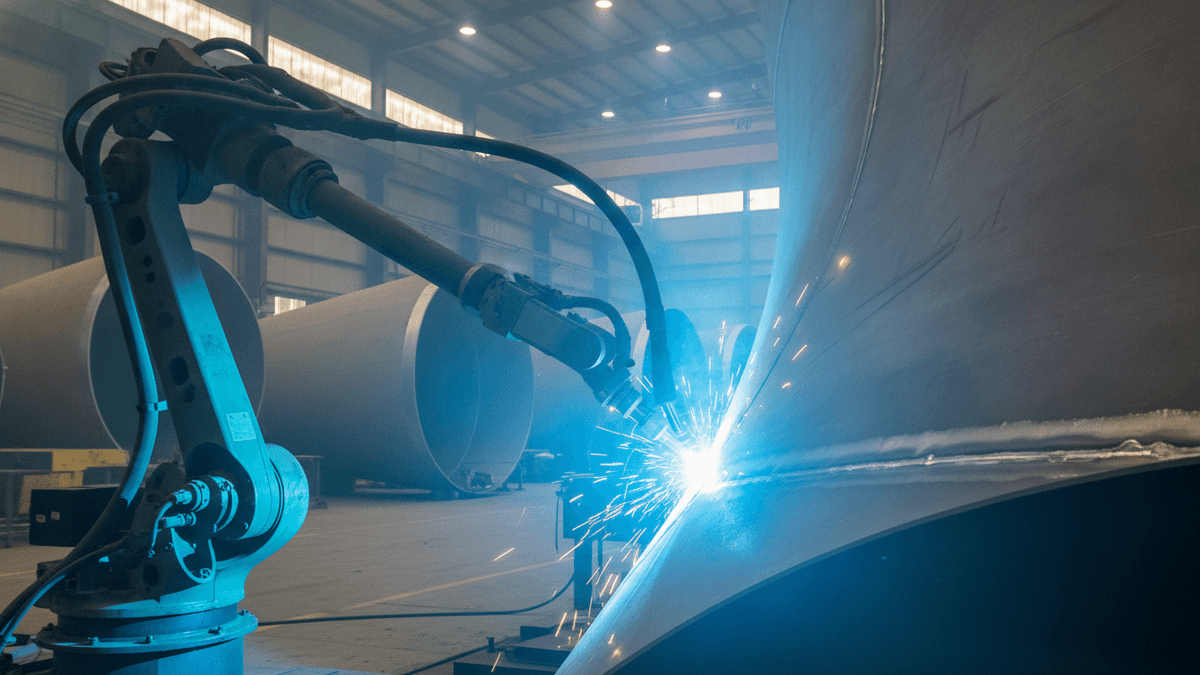
Automated plasma welding system working on a wind tower component in a Brazilian facility.
The Brazilian plasma welding machine market is experiencing a steady growth trajectory, fueled by demand from heavy industrial sectors. However, the market remains heavily reliant on imports, with 60-70% of equipment value sourced internationally due to a lack of advanced domestic manufacturing capabilities.
Key industries such as oil and gas, automotive, shipbuilding, and renewable energy infrastructure are the primary consumers, requiring high-precision welding solutions for materials like stainless steel and aluminum. The market also benefits from a consistent revenue stream from consumables, which constitute 15-20% of the total market expenditure.
A significant trend is the increasing adoption of automated plasma welding systems. These automated solutions currently account for 25-30% of market revenue and are projected to experience faster growth than the manual segment. Their application is expanding in critical areas like wind tower fabrication and oil & gas piping, supported by ongoing investments in Brazil’s infrastructure and energy sectors. Furthermore, there is a growing preference for multi-process machines and energy-efficient inverter-based power sources.
Despite the growth, the market faces considerable challenges. High import duties, ranging from 14-20%, coupled with a complex tax structure, inflate end-user prices by 40-60%. Access to certified technical support and spare parts remains uneven, particularly in regions outside major industrial hubs. Fluctuations in the prices of raw materials like steel, copper, and specialty gases also impact the cost of consumables and supply chain margins.
Market analysis indicates a Compound Annual Growth Rate (CAGR) of 4-6% between 2020 and 2025. This growth is anticipated to accelerate to 5-7% CAGR from 2026 to 2035, with the potential for market volume to double by 2035, driven by replacement demand and new industrial capacity build-outs.
While manual welding units still dominate in terms of volume (45-55%), automated systems command a larger share of the market revenue. The oil and gas sector is the largest end-use segment, representing 20-25% of demand, followed by the automotive, shipbuilding, and structural steel industries. Pricing for these machines varies widely, from BRL 8,000–20,000 for basic manual units to over BRL 300,000 for advanced automated CNC stations.
Global manufacturers such as ESAB and Lincoln Electric are key players, operating in Brazil through local subsidiaries or distributors. Domestic production is largely confined to low-end manual units and certain consumable components, reinforcing Brazil’s position as a net importer of advanced welding technology. Distribution channels typically involve a two-tier model, with manufacturers selling to authorized distributors.
Compliance with Brazilian technical standards, including ABNT NBR NM 60335-2-80 for electrical safety and NR-12 for machine safety, is mandatory. Looking ahead, opportunities for growth exist in the aftermarket for consumables, the integration of local robotic welding cells, and the provision of accredited training programs. The digitalization of welding processes also presents a promising avenue for market expansion.
About the Author